Ouzina Ordovician Graptolite Locality Fossil Hunting Guide
Image: NASA Goddard Space Flight Center from Greenbelt, MD, USA via Wikimedia Commons
Find Ordovician graptolites, trilobites, and brachiopods in Moroccan Saharan shales near Ouzina — a remote 460-million-year-old seafloor site requiring a guide.
Ouzina is a remote oasis village at the southern fringe of the Moroccan Sahara, several hours from the nearest significant town, where Ordovician shales and siltstones containing graptolite fossils outcrop across a wide area of desert pavement. Graptolites are among the most scientifically important fossils in the Paleozoic record: small colonial animals that floated in ocean surface waters and are preserved as silvery or carbon-black films on fine-grained sediment surfaces. The Ouzina area is recognised as one of the localities where Ordovician graptolites, trilobites, and brachiopods occur together in well-preserved assemblages, providing direct evidence for the marine ecosystems of 460 to 455 million years ago. This is not a site for large dramatic specimens; it rewards careful observation and patience.
This guide describes the geology and fossil types at the Ouzina locality, the logistics of reaching this remote site, and what to expect when you get there.
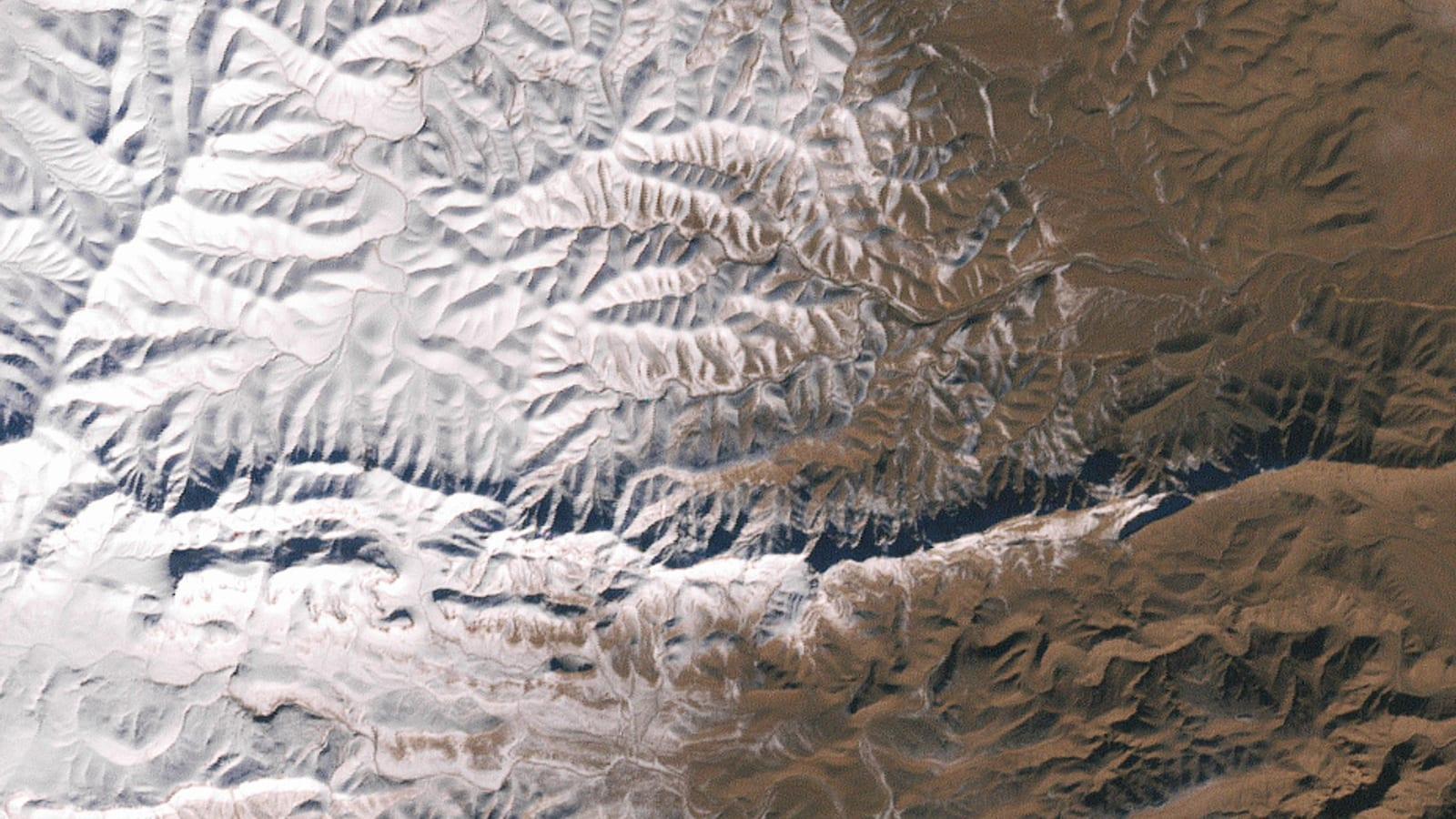
 Snow In the Sahara (31418781870).jpg. Photo: NASA Goddard Space Flight Center from Greenbelt, MD, USA via Wikimedia Commons (Public domain)
Location and Getting There
Location
Ouzina is located in the Errachidia Province of southeastern Morocco, southeast of Rissani and south of Taouz, near the Algerian border. It is one of the more remote inhabited settlements in Morocco. The surrounding Ordovician sediment exposures occur across desert terrain within a radius of roughly 10 to 30 kilometres of the village. The approximate GPS coordinates for Ouzina village are 30.72°N, 3.92°W. Because the site involves remote desert travel, organising a guide before arriving in the area is strongly recommended.
Getting There
The most practical base for accessing the Ouzina graptolite locality is Rissani, approximately 80 kilometres to the northwest. Guides and tour operators based in Rissani and Erfoud offer full-day 4WD excursions to the Ouzina area. The tracks from Rissani to Ouzina are a mix of graded piste and sandy desert track; a 4WD vehicle is required. Driving time from Rissani is approximately two to three hours one way, making this a long day trip or an overnight if you want more time in the field. A few basic guesthouses and nomadic camp accommodations are available near Ouzina for those who want to make this a two-day excursion. Do not attempt this route independently without desert navigation experience; the landscape is monotonous and route-finding is difficult without local knowledge.
What Fossils You'll Find
Graptolites are the primary fossil you are searching for at this locality. They appear as thin, saw-blade-like or thread-like impressions on the surface of dark fine-grained shale or siltstone. Individual rhabdosomes (the colony skeleton) range from 1 to 10 centimetres in length and are typically flattened. Common Ordovician graptolite genera in Moroccan successions include Didymograptus (two-branched, drooping forms), Tetragraptus (four-branched forms), and Diplograptus. Identifying the specific species requires careful examination and ideally a graptolite reference guide. The fossils occur on bedding plane surfaces, so splitting shale layers along natural planes is the most productive collecting technique.
 Figure 6 - Photographs of the graptolite Metabolograptus extraordinarius, index fossil for the base of the Hirnantian Stage.jpg. Photo: Goldman, D; Leslie, S. A.; Liang, Y.; and Bergström, S. M. via Wikimedia Commons (CC BY 4.0)
Trilobites occur in the same Ordovician succession at Ouzina and represent a significant secondary find. Ordovician trilobites from the Moroccan Sahara region are scientifically well-documented. Common genera include Neseuretus and various asaphid trilobites. Complete trilobites are the prized finds; more commonly you will encounter cephala (head shields), pygidia (tail shields), and enrolled specimens. The dark colour of the trilobites against the grey-beige matrix makes them visible with careful surface scanning.
Brachiopods complete the main assemblage, occurring both in shale beds with graptolites and in interbedded coarser-grained layers. Orthid and lingulid brachiopods are typical of Ordovician shale assemblages; most occur as flat valves on bedding surfaces alongside the graptolites.
Geologic History
The Ancient Environment
The fossil-bearing beds at Ouzina belong to the Ordovician period, most likely the Darriwilian to Katian stages, approximately 465 to 445 million years ago. During the Ordovician, Morocco was part of the passive margin of Gondwana, located at high southern latitudes — possibly 50 to 60 degrees south of the palaeoequator. The seafloor in this region received fine-grained terrigenous sediment transported from the Gondwana continent and accumulated in quiet, relatively deep water conditions below normal wave base. This depositional setting favoured graptolite preservation: the animals fell to a low-oxygen seafloor where scavengers were absent, allowing the delicate carbon-based skeletons to be preserved in the sediment.
The late Ordovician saw one of the most severe mass extinctions in Earth history, the Hirnantian extinction, triggered in part by a major glaciation of Gondwana. The ice sheet that developed over what is now North Africa left glacial deposits in the Anti-Atlas region that are visible in the geological record above the fossiliferous Ordovician shales. This extinction event wiped out a large proportion of the graptolite fauna and many other Ordovician marine groups, making the assemblages preserved at localities like Ouzina a record of a marine world that was soon to be transformed.
How the Ouzina Locality Became a Fossil Site
The Ordovician shales of the Ouzina area were deeply buried during the Paleozoic and Mesozoic, then uplifted and exposed during the Cenozoic tectonic reworking of North Africa. Arid conditions over the last several million years meant that erosion was primarily by wind and rare water events rather than by soil-building biological processes. This preserved the fine detail of graptolite impressions on shale surfaces that would otherwise have been destroyed by chemical weathering in a more humid climate. The result is that the Ouzina area preserves Ordovician shale bedding planes essentially as they were deposited, with graptolites and trilobites accessible at the surface.
Visiting and Collecting Information
Access and What to Expect
Access to the Ouzina graptolite locality is through local guides based in Rissani or Erfoud. This is a genuine remote desert excursion and is not suitable for independent travel without experience and proper equipment. A full-day guided excursion with 4WD transport from Rissani typically costs 700 to 1,200 MAD (approximately 70 to 120 USD) per person, reflecting the distance and time involved. At the site, you split shale slabs along natural bedding planes to find graptolite impressions. You may collect specimens for personal use. Prepared specimens and slabs with good graptolite material are also available for purchase from local collectors who work the area. Morocco permits tourists to export up to ten decorative fossil specimens without special documentation; retain purchase receipts.
What to Bring
This locality requires more preparation than closer desert fossil sites. Carry a minimum of four litres of water per person for a full-day outing in the desert. A geology hammer with a flat pick end is useful for splitting shale; a cold chisel helps direct splits along bedding planes. Safety glasses are essential. A hand lens at 10x helps examine fine graptolite detail in the field. Wrap specimens in newspaper for transport. Sun protection — full sun coverage including face and neck — is critical in this open desert environment. A small first aid kit is worth bringing for remote locations. Charge your phone fully before departing; GPS tracking is useful given the featureless terrain.
Safety and Practical Tips
Ouzina is a genuine deep desert location. Inform your guide or accommodation host of your exact route before departing. The proximity to the Algerian border means that some routes pass through military checkpoint areas; carry your passport at all times. Desert temperatures exceed 45°C in summer; this excursion is only realistic from October through March. Nights in the desert can be cold in winter, particularly if you are camping; temperatures can drop below 5°C in January. Respect the privacy and customs of any nomadic communities you encounter in this area. Purchase food and supplies in Rissani before the journey; there are minimal supplies available in Ouzina.
Sources
Nearby sites
 Taouz Cretaceous Fish Fossil Hunting Guidefish teeth, shark teeth, mosasaur remains
 Ziz Gorge Echinoid Site Errachidia Fossil Hunting GuideMicraster echinoids, irregular echinoids
 Boutchafine Mount Trilobite Quarry Erfoud Fossil Hunting GuidePhacops, Hollardops
 Erfoud Main Orthoceras Factory Quarry Fossil Hunting GuideErfoud Main Orthoceras Factory Quarry, Orthocerids