Stockdale Silurian Yorkshire Dales Fossil Hunting Guide
Image: Matthew Hatton via Wikimedia Commons
Stockdale near Austwick in the Yorkshire Dales exposes Silurian Stockdale Shales, the type locality for graptolite biostratigraphy in northern England.
The area around Stockdale, near Austwick in the Yorkshire Dales, is well-known to geologists as the type locality for the Stockdale Shales, a Silurian sequence deposited in a deep-water marine basin approximately 440 million years ago. The shales here preserve a rich graptolite fauna that has been used internationally to calibrate Silurian stratigraphy. For collectors, this is a site that offers something genuinely different from the Jurassic ammonite beaches and Cretaceous chalk cliffs: graptolites, the colonial floating organisms that dominate the Silurian fossil record in Britain, together with occasional brachiopods and trilobites from interbedded shallower-water horizons.
The site is an exposure of natural rock outcrops and small disused quarry sections in the limestone and shale sequence of the Yorkshire Dales, accessible on foot from the village of Austwick. Serious graptolite collectors regard this as one of the key Silurian localities in northern England. This guide covers how to reach the site, what fossils to look for, the Silurian geology of the Dales, and the practical rules governing access and collecting.
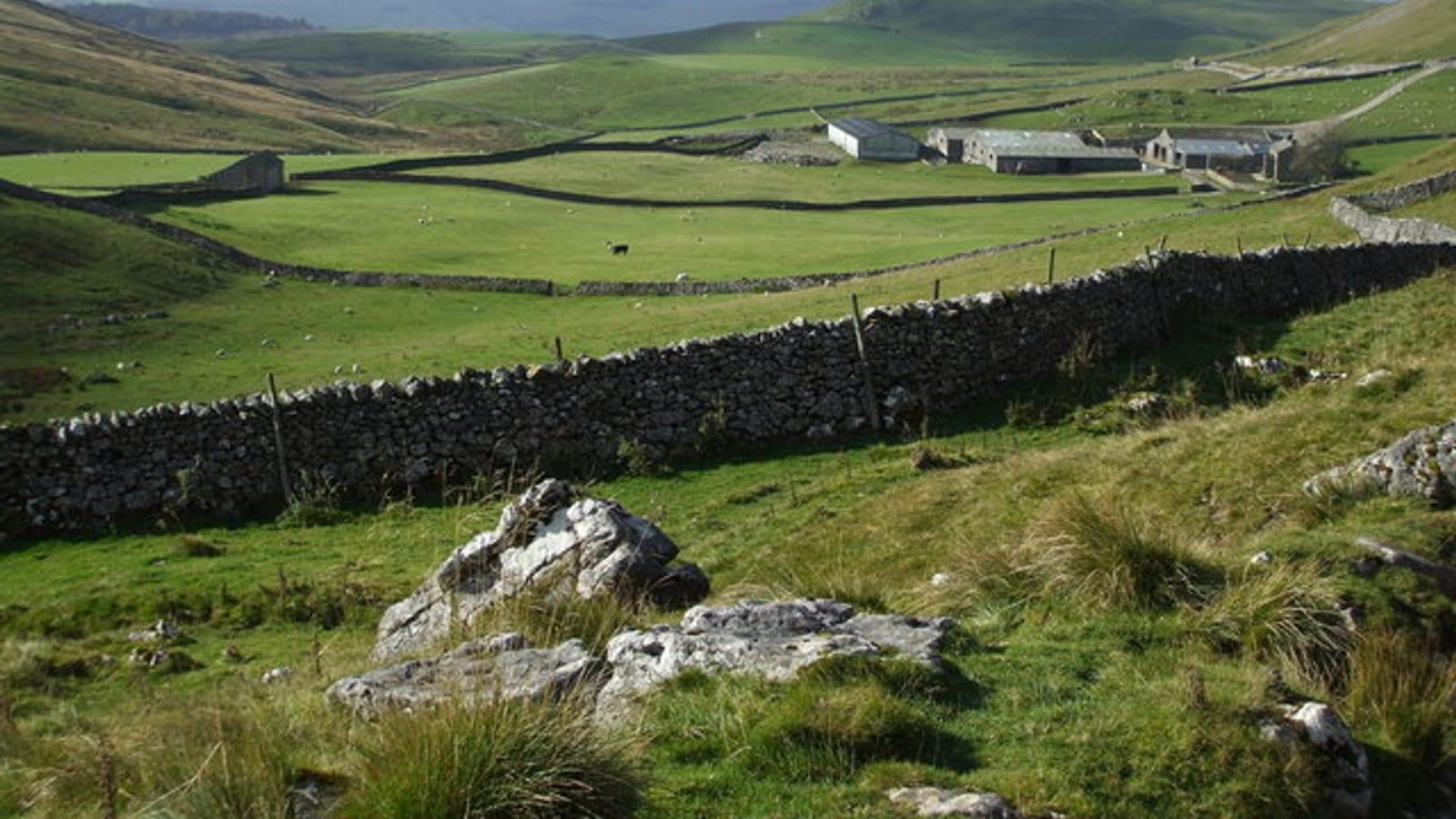
 Crutching Close, Stockdale - geograph.org.uk - 1547648.jpg. Photo: Matthew Hatton via Wikimedia Commons (CC BY-SA 2.0)
Location and Directions
Address
Stockdale, near Austwick, North Yorkshire LA2 8BB, England. The Stockdale Shales outcrops lie approximately 2 km northeast of Austwick village in Crummack Dale, within the Yorkshire Dales National Park.
Directions and Parking
From the A65 between Settle and Kirkby Lonsdale, turn north toward Austwick village. In Austwick, park in the village car park or sensibly on the roadside (do not block farm tracks). From the village, follow the footpath northeast through Crummack Dale toward Moughton. The Stockdale beck area, approximately 2 km from Austwick, is where the classic Stockdale Shale exposures appear in the stream banks and small natural outcrops beside the path.
Ordnance Survey 1:25,000 map OL2 (Yorkshire Dales South and West) covers this area. The walk in is straightforward on a clear day but the terrain is typical Dales upland: rough limestone grassland with loose rocks. Walking boots and waterproofs are required. The outcrops are in a valley bottom setting with the stream running alongside, so the ground can be wet underfoot.
What Fossils You'll Find
Graptolites are the primary fossils at Stockdale. These colonial organisms, which floated in the Silurian ocean suspended from a communal float or attached to seaweed, are preserved as flattened, carbonaceous films on the shale surfaces. They appear as thin, saw-edged or serrated lines, often in groups, on the dark grey or black shale. Under a hand lens the individual cups (thecae) that housed the animals are sometimes visible. The Stockdale Shales contain several graptolite biozones from the Llandovery and Wenlock Series, making the sequence useful for precise age determination.
 Silurian graptolite Campograptus millepeda.jpg. Photo: Emilia Jarochowska via Wikimedia Commons (CC BY-SA 4.0)
Brachiopods occur in the shelly limestone horizons interbedded with the shales, representing shallower, more oxygenated conditions when they periodically returned to the basin. Stricklandia and Pentamerus are among the genera that characterise Silurian brachiopod faunas from the Welsh Borderlands and northern England.
Trilobites are less common but have been reported from the interbedded limestone horizons at comparable Silurian sites in the Dales. They occur as fragments, particularly the distinctive, crescent-shaped pygidium. Complete specimens are rare.
Crinoid columnals occur in the shelly horizons alongside brachiopods, appearing as small disc or star-shaped segments of the stem.
Geologic History
The Ancient Environment
The Stockdale Shales were deposited during the Llandovery to Wenlock Series of the Silurian period, approximately 440 to 425 million years ago. At this time, what is now northern England lay at approximately 20 degrees south latitude, on the margins of the Laurussian continent following the closure of the Iapetus Ocean. The Silurian Welsh Basin, which extended into what is now the Pennines and Dales, accumulated thick sequences of deep-water turbidite mudstones and fine-grained sediments in a subsiding marine trough.
The shale facies at Stockdale records deposition in relatively deep, poorly oxygenated water where bottom currents were weak and oxygen levels were too low to support an active benthic community. Graptolites flourished in the water column above, drifting on ocean currents and feeding on plankton, and their remains sank to the quiet muddy floor where they were preserved. Periodic shallowing of the basin or influxes of better-oxygenated water allowed shelly faunas to colonise the bottom temporarily, producing the interbedded limestone horizons with their brachiopod faunas.
How Stockdale Became a Fossil Collecting Site
The Caledonian orogeny, which built the mountain belt across northern Britain during the Devonian, folded and faulted the Silurian sediments and eventually uplifted them to form the basement beneath the Yorkshire Dales. Subsequent erosion during the Carboniferous and then post-glacial incision by streams exposed the Silurian basement in river valleys and stream banks where the overlying Carboniferous Limestone is locally thin or absent. Stockdale Beck has cut down through the Carboniferous to expose the older Silurian shales in its stream banks, creating the accessible outcrops that make this a known fossil locality.
Collecting Rules and Regulations
Is Fossil Collecting Allowed?
The Stockdale area falls within the Yorkshire Dales National Park. The outcrops beside Stockdale Beck are on private land (farmland), and formal access is via the public footpath through Crummack Dale. Collecting fossils from private land, even when accessed via a public right of way, requires the landowner's permission. The footpath gives you the right to walk through; it does not give you the right to remove rock or fossils.
The Stockdale Shales are a nationally important geological type section and the Natural Environment and Rural Communities Act 2006 (NERC Act) provides some protection for significant geological sites in England and Wales. If the outcrops are SSSI-designated, which they may be given their stratigraphic importance, additional restrictions apply. Contact Natural England or the Yorkshire Dales National Park Authority to check the SSSI status and to seek guidance on access for geological study before visiting with the intention of collecting.
Recommended Tools
A geological hammer, fine chisels, and a hand lens are the appropriate tools for shale splitting. The shales split along bedding planes; even gentle taps with a chisel can open the rock along these planes. Graptolites are best seen with a x10 hand lens. Carry a stiff brush to clean shale surfaces. Photograph specimens in place before removing them. The dark shale is heavy; bring padded bags and do not over-collect.
Safety
The Crummack Dale path is a well-maintained Yorkshire Dales footpath but the terrain is typical upland moorland. Wear sturdy waterproof boots. The stream bank sections are at the edge of Stockdale Beck, which can flood after heavy rain; do not work in the stream bed during or after wet weather. The limestone pavements in the surrounding area have deep grikes (fissures) that can trap an ankle; watch your footing when crossing open limestone ground. Check weather forecasts before setting out; high ground in the Dales can be mist-covered with little warning.