Staithes Yorkshire Guide Fossil Hunting Guide
Image: Bill Boaden via Wikimedia Commons
Find ammonites, trace fossils, and bivalves on the Early Jurassic foreshore at Staithes, North Yorkshire. Free surface collecting on the Yorkshire Dinosaur Coast.
Staithes is one of the most accessible ammonite sites on the Yorkshire coast, and it rewards visitors who time their trip with low tide and a keen eye. The village sits within the North York Moors National Park on the edge of the Yorkshire Dinosaur Coast, and the foreshore exposes a sequence of Early Jurassic mudstones, shales, and sandstones rich in ammonites, bivalves, and trace fossils. Ammonites here are common enough that you rarely need to walk far from the harbour to find them. They turn up in nodules along the foreshore, in ledges that break clean on impact, and loose on the beach surface after storms have done the preliminary work. This guide covers the approach to this historic fishing village, what the foreshore yields, the geological story behind these 200-million-year-old seas, and what collecting rules apply on this SSSI-designated coast.
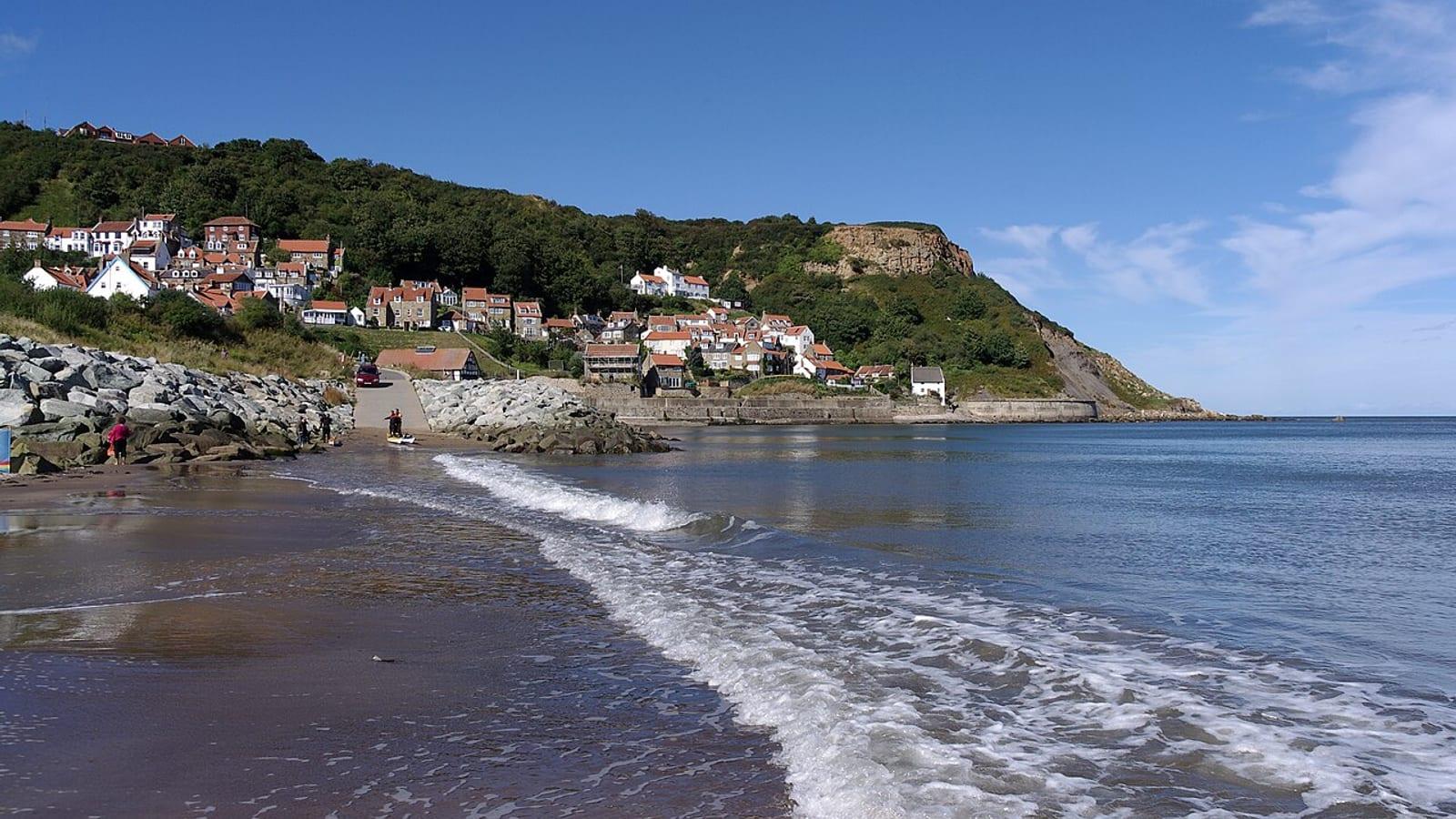
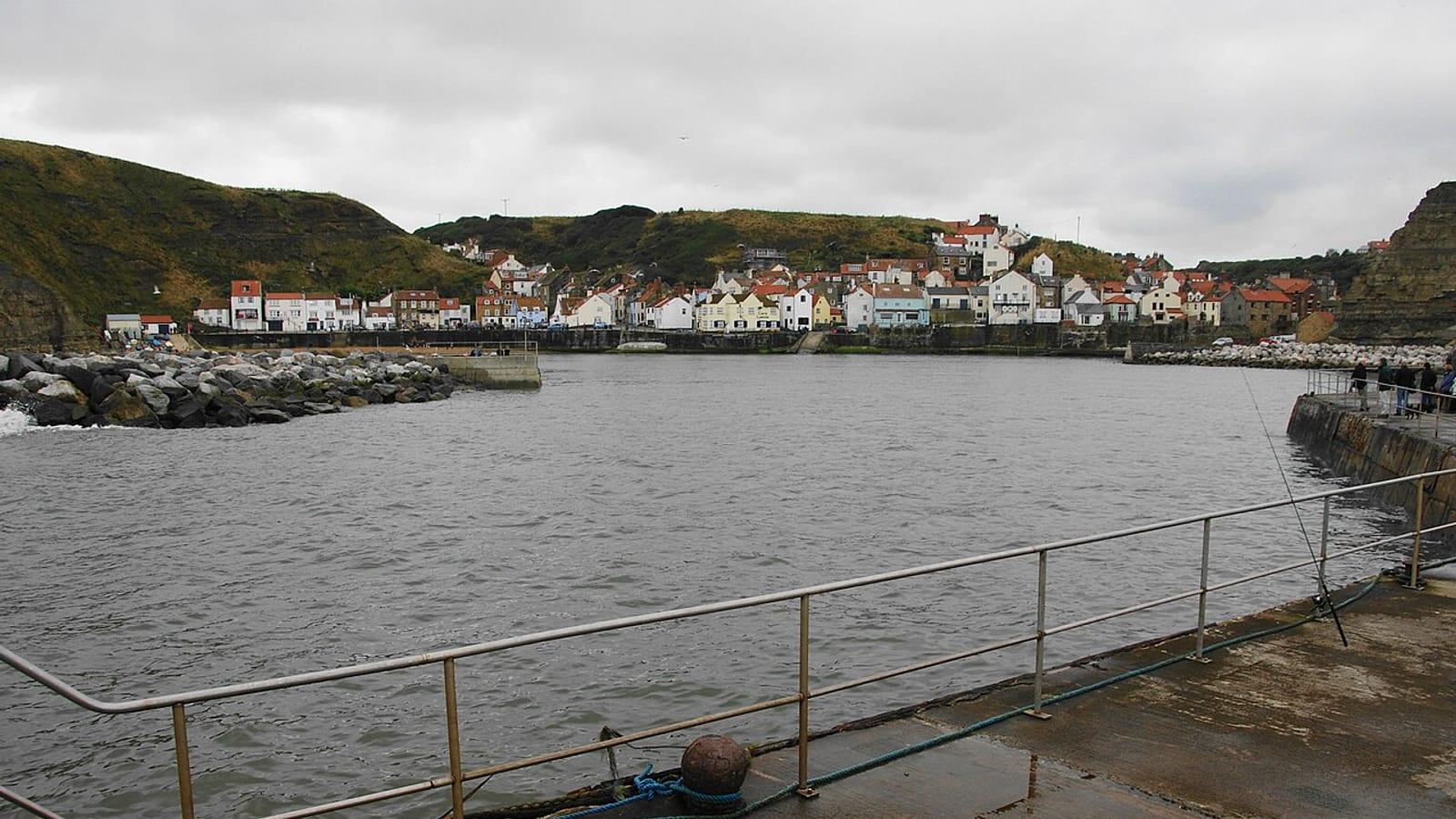
 Staithes Harbour - geograph.org.uk - 4183096.jpg. Photo: Bill Boaden via Wikimedia Commons (CC BY-SA 2.0)
Location and Directions
Address
Staithes Car Park, top of cliffs, Staithes, Saltburn-by-the-Sea, North Yorkshire, TS13 5DH.
Directions
Staithes lies off the A174 between Saltburn-by-the-Sea and Whitby. From the A174, follow the signs into Staithes village. The main car park sits at the top of the cliffs above the village and charges a daily parking fee; it fills quickly in summer, so arrive early. From the car park, a steep path descends into the historic village centre. A handrail assists on the steepest section. Alternatively, you can drop passengers at the bottom of the hill and drive back up to the car park yourself. Parking within the old village is restricted to permit holders only. Approximately 40 minutes of roadside parking is sometimes available near the Cobbles Coffee Shop. From the village, access the foreshore either via the steep main path or via the gentler Old Stubble path that leads down beside the Cod and Lobster pub toward the harbour. The beach and foreshore are accessible from roughly two hours either side of low tide, and the best fossil exposures are on the flat rock ledges and in the shale beds at low water.
What Fossils You'll Find
Ammonites are the principal find at Staithes. The most frequently encountered genus is Amaltheus, a distinctive ribbed ammonite with a keel along its outer edge. Specimens range from coin-sized to fist-sized and occur both as three-dimensional shells in nodules and as flattened compressions in shale. Look for nodules on the foreshore platform and crack them with a geological hammer to reveal the interior. Ammonites also weather out of shale ledges and can be found lying loose on the beach, particularly after storms.
 Ammonite fossil 3.jpg. Photo: Michael Rowe via Wikimedia Commons (CC BY-SA 4.0)
Bivalves and brachiopods are present throughout the shale and mudstone beds. The shell beds at the boundaries between the Redcar Mudstone Formation and the Staithes Sandstone Formation, including the Avicula and Pecten Seams, are particularly rich in small molluscs. These shell concentrations form thin, laterally extensive layers that are visible as slightly harder, more resistant bands in the cliff face.
Trace fossils are a distinctive feature of Staithes. Rhizocorallium, a U-shaped burrow produced by a shrimp-like organism, appears in the Cleveland Ironstone Formation. These horizontal burrows with spreite fill are immediately recognisable once you know what to look for and make excellent display specimens.
Ichthyosaur and plesiosaur remains have been recovered from this stretch of coast historically, though they are rare finds for the casual visitor. Keep an eye out for dark, dense bone fragments in the shale, particularly in freshly fallen cliff material. Never approach or shelter under the cliffs.
Geologic History
The Ancient Environment
The rocks at Staithes span the Hettangian to Sinemurian stages of the Early Jurassic, deposited approximately 195 to 200 million years ago. The sequence includes the Redcar Mudstone Formation, the Staithes Sandstone Formation (where the formation boundary marks important shell beds), and the Cleveland Ironstone Formation with its historically mined Main Seam. These grey-blue marine shales, mudstones, and sandstones were laid down in a warm, shallow sea with strong deltaic influence from rivers draining the adjacent land. Alternating lithologies indicate a constantly shifting environment between fully marine conditions and periods of stronger terrestrial input. The shell beds at formation boundaries mark episodes when marine conditions were most stable and marine life most abundant. The ironstone bands indicate intervals of anoxic bottom-water conditions in which iron-rich sediment accumulated. Lignite and occasional jet within some beds preserve driftwood from forests growing on the nearby deltaic lowlands.
How Staithes Became a Fossil Collecting Site
The Yorkshire coast between Port Mulgrave and Whitby is subject to continuous wave erosion that cuts back the soft shale cliffs at a measurable rate each year. This ongoing erosion steadily exposes new rock surfaces and releases fossils that would otherwise remain buried. The same coastal processes that threaten historic buildings in the village ensure a regular supply of fresh specimens on the foreshore. The site is part of the Yorkshire Dinosaur Coast, a 60-kilometre stretch of coastline designated for its exceptional Jurassic fossil record, and it carries SSSI status for its geological significance.
Collecting Rules and Regulations
Is Fossil Collecting Allowed?
Surface collecting of loose fossils from the beach and foreshore at Staithes is permitted for personal, non-commercial purposes at no charge. The site is within a Site of Special Scientific Interest, which means that hammering the in-situ cliff faces is prohibited. You may collect loose material from the beach and foreshore, and you may carefully split nodules found on the beach surface. Do not dig into the cliff base or remove material directly from the cliff face. Significant or scientifically important finds, particularly marine reptile remains, should be reported to the Yorkshire Museum or the Yorkshire Coast Geology Group.
Recommended Tools
A geological hammer and selection of chisels are useful for splitting nodules found on the foreshore. Bring a hand lens for examining small ammonite details and trace fossils. Wrap specimens in newspaper or bubble wrap for transport. Wear sturdy, waterproof footwear with good ankle support, as the foreshore ledges are uneven and the shale surfaces slippery when wet.
Safety
The cliffs at Staithes are actively eroding and extremely dangerous. Never stand at the base of the cliffs, never shelter under cliff overhangs, and never approach fresh cliff falls, which may be followed by further collapses. The tides on this stretch of coast can cut off sections of the foreshore quickly; always check the tide times for Whitby before visiting and leave the foreshore at least an hour before the predicted high tide. The path into the village is very steep and can be slippery in wet weather.