Cayton Bay Yorkshire Fossil Hunting Guide
Image: Christine Matthews via Wikimedia Commons
Cayton Bay on the Yorkshire coast exposes faulted Jurassic formations yielding ammonites, bivalves, and brachiopods from Callovian to Oxfordian shallow marine seas.
Cayton Bay sits between Scarborough and Filey on the Yorkshire coast, and the foreshore here exposes a geologically complex sequence spanning the Middle to Late Jurassic, from the Callovian through the Oxfordian, roughly 166 to 157 million years ago. The Cayton Fault system brings multiple formations to beach level in close proximity: the dark Oxford Clay, the nodular Cornbrash limestone, the Cayton Clay, Calcareous Grit sandstones, and the Hambleton Oolite all appear within a short stretch of foreshore, each with its own characteristic fossil assemblage.
Collectors find ammonites, bivalves, gastropods, brachiopods, belemnites, and plant material here depending on which formation is exposed at any given visit. Sand cover varies considerably with the seasons and after storms, so the available collecting surface changes from visit to visit. The bay is also a popular surf spot, which means the beach is rarely empty, but there is enough foreshore at low tide that collectors and surfers coexist without difficulty. This guide explains how to reach the bay, what the different formations yield, the geological history behind the complex stratigraphy, and the rules that apply to collecting.
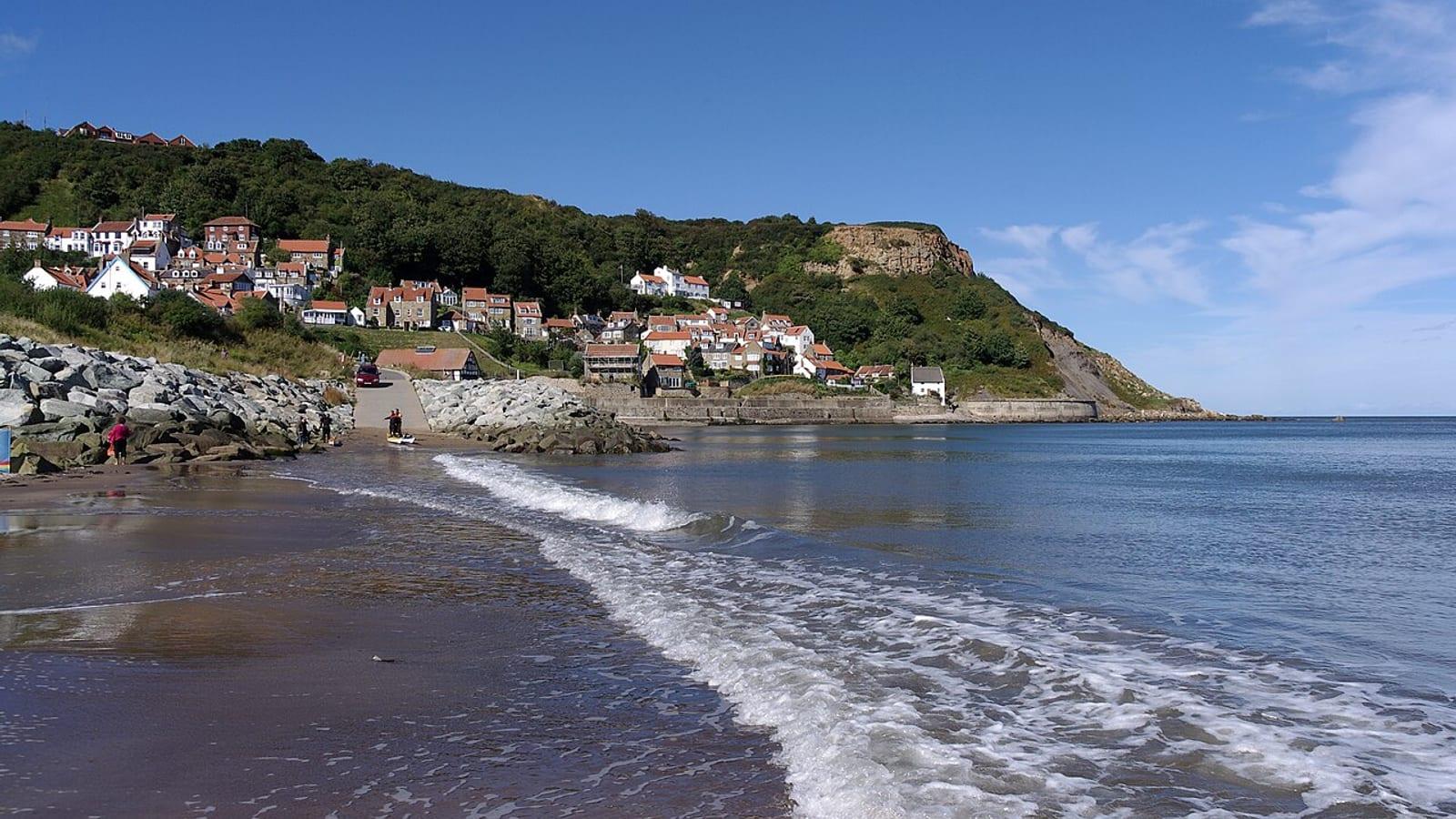
 Cayton Bay, Yorkshire - geograph.org.uk - 4601700.jpg. Photo: Christine Matthews via Wikimedia Commons (CC BY-SA 2.0)
Location and Directions
Address
Cayton Bay, between Scarborough and Filey, North Yorkshire YO11 3NJ, England. The bay lies approximately 5 km south of Scarborough town centre and 3 km north of Filey.
Directions and Parking
From the A165 between Filey and Scarborough, turn east at the Cayton Roundabout. If approaching from the south, take the first right after the roundabout. If approaching from the north, take the second turning to Cayton. Follow the well-maintained road downhill toward the bay; it ends at a small car park above the beach (seasonal charges apply). Steps descend from the car park to the beach.
Once on the beach, walk north or south along the bay depending on conditions. The northern end of the bay, near the point, tends to expose more of the Oxford Clay and Cornbrash. The central and southern sections reveal Calcareous Grit sandstone beds and Cayton Clay. Sand levels vary; after storms the sand cover strips back and exposes more foreshore rock. Spring low tides give the best access to the outer reef structure and deepest foreshore exposures.
What Fossils You'll Find
Ammonites are the primary target at Cayton Bay. The Oxford Clay and Cayton Clay yield Callovian to Oxfordian ammonites including cardioceratids, Quenstedtoceras, and Kosmoceras in the Oxford Clay facies. These typically occur as internal moulds in the grey-brown mudstone or in mudstone nodules. The Cornbrash Formation above yields its own fauna of robust, nodular ammonites. Specimens range from small, palm-sized forms to occasional large ammonites exceeding 20 cm.
 Ammolite from Placenticeras fossil ammonite (Bearpaw Formation, Upper Cretaceous, 70-75 Ma; mine in St. Mary River Valley, Alberta, Canada) 6 (39534752580).jpg. Photo: James St. John via Wikimedia Commons (CC BY 2.0)
Bivalves are common across all formations. Trigonia and related species occur in the Cornbrash and Calcareous Grit, often well-preserved with original shell material. Gryphaea (the devil's toenail) is found in the Oxford Clay and is easily recognisable by its curved, asymmetric shell.
Gastropods occur in the Cornbrash and Calcareous Grit, particularly in coarser-grained sandy horizons where shell material is better preserved than in the clays.
Brachiopods are found in the Cornbrash Formation, where they can be locally abundant in specific nodular limestone horizons. Rhynchonellid and terebratulid brachiopods are the most frequent types.
Belemnites are present throughout the Jurassic sequence here and are common loose finds on the foreshore across all beds.
Plant material including driftwood casts and occasional leaf impressions occurs in the Calcareous Grit sandstones, which were deposited in a shallower, more coastal environment where terrestrial material could wash in.
Geologic History
The Ancient Environment
The strata at Cayton Bay span the Callovian to Oxfordian stages of the Middle to Late Jurassic, approximately 166 to 157 million years ago. The sequence records a progression from the relatively deep, muddy Oxford Clay sea through shallower, more energetic conditions represented by the Calcareous Grit sandstones and the Hambleton Oolite.
During Callovian time, an open, moderately deep shelf sea covered Yorkshire. The Oxford Clay accumulated as fine muds on the quiet sea floor, preserving a diverse fauna of swimming ammonites and belemnites alongside bottom-dwelling bivalves and brachiopods. By Oxfordian time the sea became shallower and more turbulent, with calcareous sand shoals and oolite banks developing. The Calcareous Grit Formation records high-energy, shallow-water conditions, and the Hambleton Oolite represents a period of carbonate sand sheet deposition similar to parts of the modern Bahamas platform.
The Cayton Fault, which runs roughly northwest to southeast across the bay, has offset these formations vertically, bringing rocks of different ages into contact along the beach and creating the geological complexity that makes the site both productive and geologically interesting.
How Cayton Bay Became a Fossil Collecting Site
Coastal erosion by the North Sea has stripped the glacial till cover that once blanketed much of the Yorkshire coast, exposing the underlying Jurassic formations on the foreshore and in the low cliffs at the back of the bay. The Cayton Fault brought multiple formations to the same level, concentrating several different fossil assemblages within a short stretch of beach. Wave action and storm events continue to clean the foreshore and expose fresh material. The reef of rock visible at low water on the outer part of the bay is a Calcareous Grit sandstone that resists erosion, protecting the softer clays inland and creating a sheltered bay where sediment transport is complex.
Collecting Rules and Regulations
Is Fossil Collecting Allowed?
Cayton Bay is a Site of Special Scientific Interest, protected for its geological interest as an important and accessible Middle to Late Jurassic coastal section. SSSI designation permits loose surface collecting with hand tools; hammering into in-situ cliff faces or digging into the foreshore rock is not permitted without a Natural England research licence. Collect loose material from the beach and from already-fallen blocks only.
The bay is also a popular bathing and surfing beach; be considerate of other users. There are no site wardens at Cayton Bay, but the Natural England SSSI notification means that deliberate damage to the geological exposure is a criminal offence.
Recommended Tools
A geological hammer, chisels, and a hand lens are the standard kit. The mudstones of the Oxford Clay and Cayton Clay can be split along bedding planes. Clay specimens tend to dry out and crack after collection; wrap them in damp tissue or treat them with diluted PVA as soon as possible. Bring a suitable container for clay specimens, which cannot be placed loosely in a rucksack. Knee pads help for extended foreshore searching.
Safety
Cayton Bay is a relatively safe beach compared to cliff-backed sites elsewhere on the Yorkshire coast, but there are hazards. The outer reef creates strong currents at the ends of the bay at certain tide states; do not wade beyond the safe bathing areas. The clay foreshore is slippery when wet. The cliff at the back of the bay is actively eroding and slumping, particularly in wet weather; keep away from the cliff base. Check tide times; the lowest tides give access to the most productive outer foreshore sections.