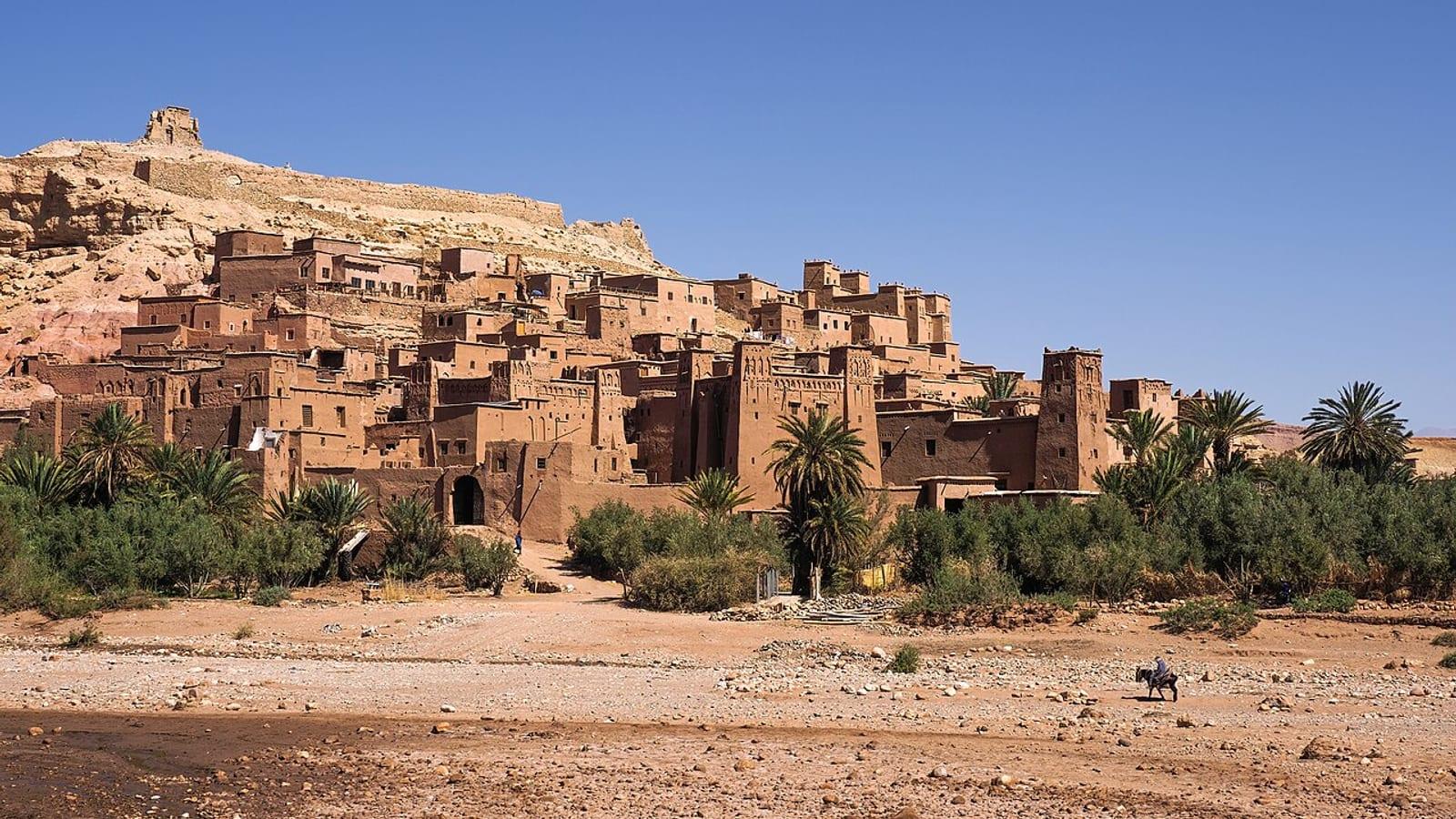
Ait Benhaddou Echinoid Site Ouarzazate Fossil Hunting Guide
Image: Petar Milošević via Wikimedia Commons
Collect Cretaceous echinoids, brachiopods, and gastropods near the UNESCO ksar of Ait Benhaddou, Ouarzazate Province, Morocco, with a local fossil guide.
A short drive from Ouarzazate, the Ait Benhaddou Echinoid Site sits in the sun-baked foothills of the Anti-Atlas, where Cretaceous marine limestone has been folded and tilted by millions of years of tectonic pressure. The rock here preserves Cretaceous echinoids — sea urchins — in impressive numbers, along with associated brachiopods and gastropods that once populated a warm, shallow sea overlying what is now the pre-Saharan plateau. The locality has attracted both commercial collectors and visiting fossil hunters for decades, and its proximity to the UNESCO-listed ksar of Ait Benhaddou makes it one of the more accessible field sites in the Ouarzazate Province.
This guide covers the geology underlying the site, the fossils you can expect to find, how to get there from Ouarzazate, and what you need to know about collecting, fees, and seasonal conditions before you travel.
 Ksar Aït Benhaddou, Marocco (أيت بن حدو، المغرب, ⴰⵢⵜ ⵃⴰⴷⴷⵓ).jpg. Photo: Petar Milošević via Wikimedia Commons (CC BY-SA 4.0)
Location and Getting There
Location
The Ait Benhaddou Echinoid Site is located in the Ouarzazate Province of southeastern Morocco, in the Draa-Tafilalet region. The nearest major landmark is the ksar of Ait Benhaddou itself, a fortified village on the old caravan route between the Sahara and Marrakech, inscribed on the UNESCO World Heritage List in 1987. The fossil outcrops occur on hillsides and in dry wadis within approximately 5 to 10 kilometres of the ksar. Coordinates for the general area centre on approximately 31.04°N, 7.13°W, though specific productive outcrops vary and a local guide is essential for locating them reliably.
Getting There
From Ouarzazate, take the N9 highway west toward Marrakech for approximately 30 kilometres to the Ait Benhaddou turn-off. Local fossil guides and fossil dealers operating in the Ouarzazate medina and along the road to Ait Benhaddou can arrange direct transport to the collecting sites in 4WD vehicles. The tracks leading to productive outcrops are unpaved and uneven; a standard rental car is not suitable. Travel time from central Ouarzazate to the site is typically 45 to 75 minutes depending on which outcrops your guide targets. Many guides offer combined cultural and fossil excursions that include a visit to the ksar itself, which makes practical sense given the proximity.
What Fossils You'll Find
Cretaceous echinoids are the dominant find at this locality. The most commonly encountered forms are Hemiaster and related irregular echinoids — heart-shaped sea urchins that burrowed through soft seafloor sediment. Complete tests (the shell or test of a sea urchin) are found, as are partial specimens. Look for the characteristic five-petal ambulacral pattern on the upper surface of intact examples. Better-preserved specimens retain the fine tubercle patterning on the test surface.
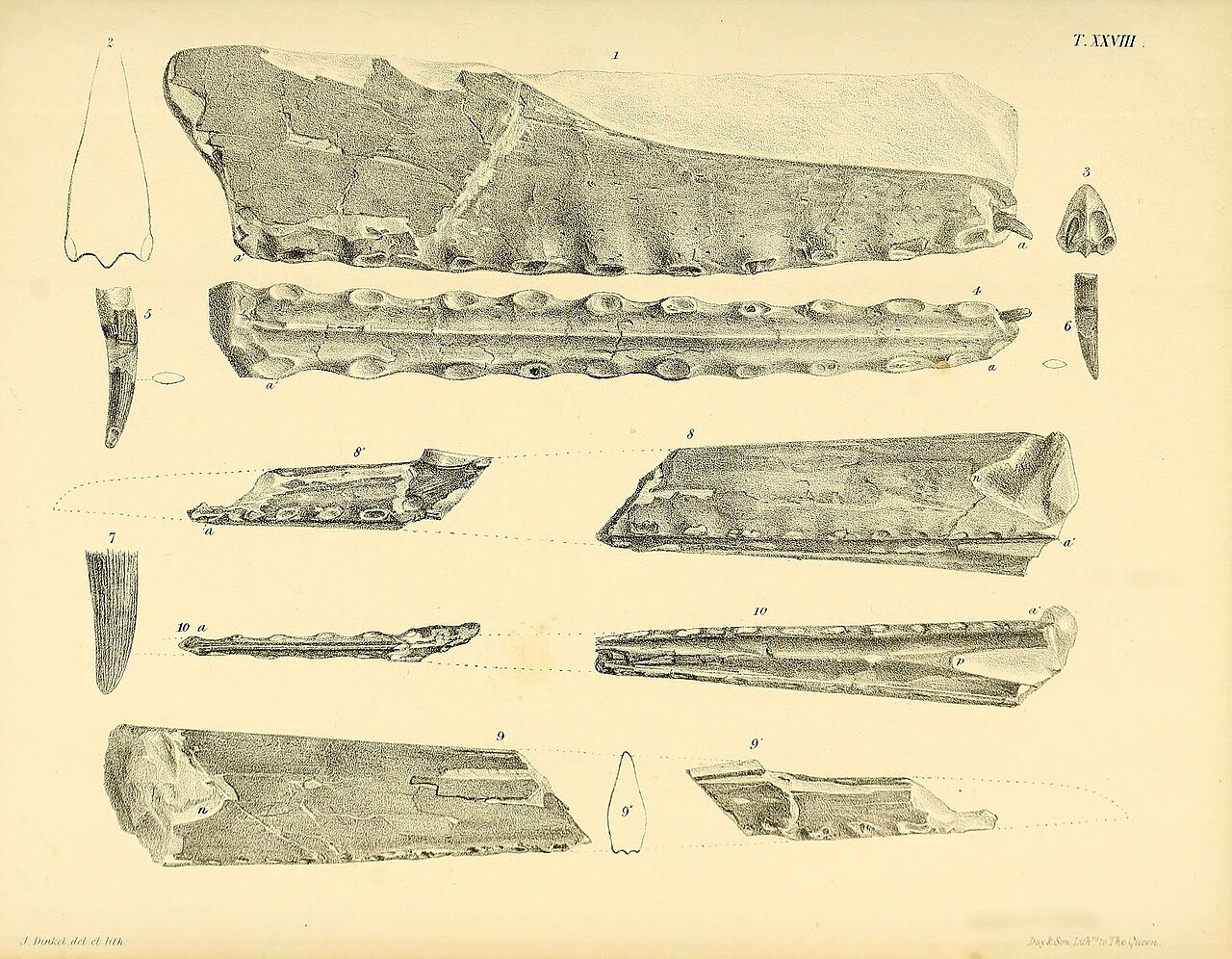 A monograph on the fossil Reptilia of the Cretaceous formations (Tab. XXVIII) BHL40609042.jpg. Photo: Owen, Richard via Wikimedia Commons (Public domain)
Brachiopods occur alongside the echinoids in the same limestone beds. These bivalve-like creatures are not true molluscs; they filter-fed from the seafloor and are common in shallow Cretaceous carbonate environments across North Africa. Terebratulid brachiopods are the most frequent type here, typically appearing as smooth, oval shells 2 to 5 centimetres in length.
Gastropods appear less frequently but are present in some beds, usually as internal moulds rather than as preserved original shell material. When you find a gastropod, note whether it shows the original coiling geometry, which helps with identification.
Occasional bivalves and coral fragments also occur in the matrix. Loose specimens weathered from the outcrop are easier to collect than matrix-embedded ones and represent the bulk of what most visitors take home.
Geologic History
The Ancient Environment
The limestone beds at the Ait Benhaddou site were deposited during the Cretaceous period, most likely the Cenomanian to Turonian stages, approximately 100 to 89 million years ago. At that time, the region that is now southeastern Morocco lay beneath a broad epicontinental sea — the southern arm of the Tethys Ocean. Water depth was shallow, probably less than 100 metres, and sea surface temperatures were substantially warmer than today. This warm, sunlit, carbonate-rich environment supported abundant benthic life: sea urchins burrowing through lime mud, brachiopods anchored to the seafloor, and gastropods moving across the substrate.
The sediments accumulated as lime muds and bioclastic sands, which lithified over time into the pale grey and beige limestones visible in outcrop today. Uplift associated with the collision of the African and European plates during the Cenozoic tilted and exposed these Cretaceous sequences across much of the Anti-Atlas and the pre-Saharan plateau. Subsequent arid erosion stripped away overlying sediment to reveal the fossil-bearing beds now accessible at surface.
How the Ait Benhaddou Echinoid Site Became a Fossil Site
The combination of Cretaceous marine deposition and later tectonic uplift is responsible for bringing these fossils to the surface. The Anti-Atlas Mountains form a long uplifted block where ancient and Mesozoic rocks have been pushed to the surface and then sculpted by tens of millions of years of erosion in an increasingly arid climate. The dry wadis and eroded hillsides in the Ouarzazate region expose successive marine limestone beds at the surface over a wide area. Local communities have been aware of fossils in these rocks for generations, and systematic commercial collection expanded significantly from the 1980s onward as international demand for Moroccan fossils grew.
Visiting and Collecting Information
Access and What to Expect
Access to productive outcrops at this locality is best arranged through a local fossil guide based in Ouarzazate or at Ait Benhaddou. Guides can be contacted through fossil shops in the Ouarzazate medina or through guesthouses in the Ait Benhaddou area. Typical half-day excursion fees run from 300 to 600 MAD (approximately 30 to 60 USD) per person, which usually includes transport and basic guidance on identifying and collecting specimens. You may collect loose surface specimens and can purchase additional prepared fossils from local collectors at the site or in town.
Morocco's export regulations allow tourists to take up to ten decorative fossil specimens out of the country without a special permit, provided the specimens are for personal, non-commercial use. Keep any purchase receipts for customs inspections at departure. Large or scientifically significant specimens may require documentation from the Moroccan Ministry of Energy and Mines.
What to Bring
Carry at least two litres of water per person for a half-day excursion; more in summer. The terrain involves walking on loose rock and uneven hillside surfaces, so sturdy ankle-supporting boots are preferable to trainers. Bring a geology hammer and cold chisels if you intend to work the outcrop rather than collect surface specimens only. Safety glasses protect against rock chips when hammering. Wrap specimens in newspaper or foam to protect them during transport. Sun protection — hat, sunscreen, light long sleeves — is non-negotiable in the Ouarzazate region at any time of year.
Safety and Practical Tips
The Ouarzazate region experiences extreme summer heat, with daytime temperatures regularly exceeding 40°C (104°F) from June through August. Plan visits for the morning hours during this period. October through April offers the most comfortable field conditions, with daytime temperatures between 20 and 30°C (68 and 86°F). Rain is rare but can make unpaved tracks temporarily impassable; check local forecasts before driving to remote outcrops. Carry cash in Moroccan dirhams, as card payment is not available at most field sites. Negotiate guide fees before departing.
Sources
Nearby sites
 Draa Valley Ordovician Trilobite Site Agdz Fossil Hunting GuideDraa Valley Ordovician Trilobite Site, Giant trilobites
 Jbel Gara el Zguilma Trilobite Site Foum Zguid Fossil Hunting GuideWalliserops trifurcatus, Psychopyge elegans
 Fezouata Biota Locality Zagora Fossil Hunting Guideanomalocaridids, Trilobites
 Bou Dib Fossil Site North Jbel Isoumour Alnif Fossil Hunting GuideBou Dib, Phacops