Kem Kem Dinosaur Fossil Beds Taouz Fossil Hunting Guide
Image: Diego Delso via Wikimedia Commons
Explore the Kem Kem Beds near Taouz, Morocco, where Cretaceous sandstones yield Spinosaurus teeth and Carcharodontosaurus bones with local guide access.
The Kem Kem Beds near Taouz, Morocco, represent one of the most predator-dense dinosaur faunas yet described from the Cretaceous period. The red and orange sandstones of the Kem Kem Group, also known as the Continental Intercalaire, have produced Spinosaurus aegyptiacus teeth by the thousands alongside bones of the massive theropod Carcharodontosaurus saharicus, whose skull rivals that of Tyrannosaurus in length. These rocks formed in a vast river delta system roughly 95 to 100 million years ago, when what is now the Sahara was a network of channels draining northward into the nascent Tethys Sea. For collectors willing to travel into southeastern Morocco's remote hammada terrain, the site offers direct contact with one of the most productive Early Cretaceous continental fossil beds in the world.
This guide covers the geology of the Kem Kem Group, how to reach the outcrops from Taouz, what fossils you are likely to find, how collecting and purchasing arrangements typically work, and what to bring for a safe and productive visit.
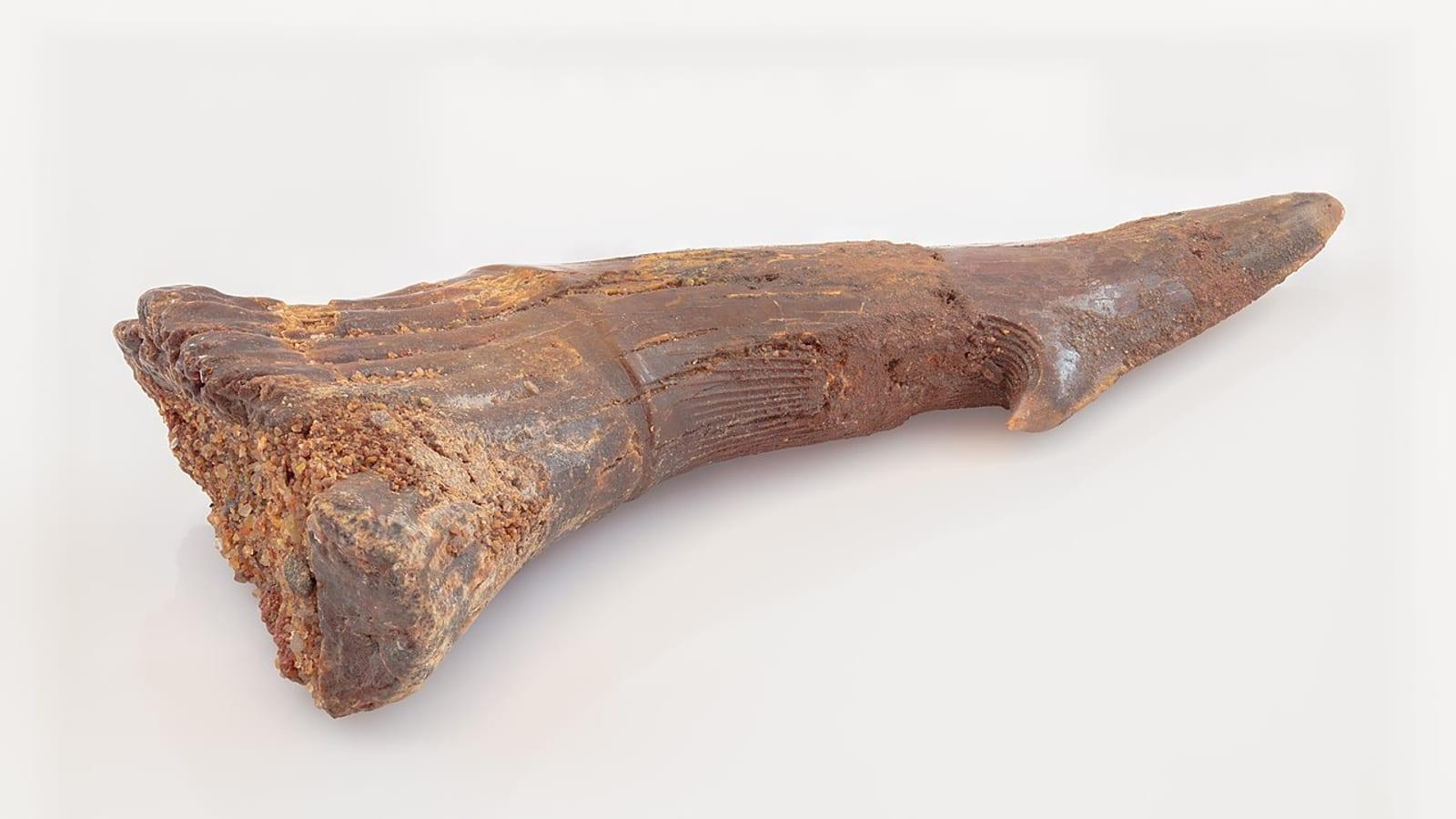
 Diente rostral de un pez sierra extinto (Onchorpristis numidus), Kem Kem, Marruecos, 2021-01-15, DD 187-243 FS.jpg. Photo: Diego Delso via Wikimedia Commons (CC BY-SA 4.0)
Location and Getting There
Location
The Kem Kem fossil beds extend across a broad escarpment along the Moroccan-Algerian border in the Draa-Tafilalet region of southeastern Morocco. The town of Taouz sits at the southern edge of this plateau, approximately 100 km southeast of Erfoud and around 130 km south of Errachidia. The GPS coordinates for the general Taouz area are approximately 30.87°N, 4.00°W, though specific quarry locations vary and are best confirmed with a local guide.
Getting There
From Errachidia, take the N13 south through Erfoud and Rissani, then continue on the P3454 toward Taouz. The paved road ends before you reach the most productive outcrops, and the final approach requires a 4WD vehicle or a local guide with a suitable vehicle. From Taouz village the fossil outcrops are typically reached in 20 to 40 minutes via unpaved piste tracks, depending on the destination and recent weather conditions. Heavy rains, though infrequent, can briefly render the tracks impassable. Arrange transport and guide services through guesthouses in Erfoud or Rissani, or contact established fossil dealers in those towns who can connect you with quarry workers near Taouz. There is no public parking infrastructure at the fossil beds themselves.
What Fossils You'll Find
Spinosaurus aegyptiacus teeth are the single most commonly encountered fossil at the Kem Kem sites. The teeth are conical, smooth-sided, and slightly curved, typically measuring between 3 and 8 cm in length, with a distinctive round cross-section that separates them from the blade-like teeth of other theropods. Wear-polished tips suggest Spinosaurus used these teeth to grip slippery fish rather than tear flesh. You will encounter isolated teeth most frequently; complete Spinosaurus specimens are vanishingly rare and have largely been removed by professional operations.
 Spinosaurus Crane.jpg. Photo: Didier Descouens via Wikimedia Commons (CC BY-SA 4.0)
Carcharodontosaurus saharicus teeth also occur here, identified by their broad, blade-like profile with serrated edges on both carinae. These are less common than Spinosaurus teeth and proportionally larger, often exceeding 10 cm in larger individuals.
Fish fossils are abundant throughout the Kem Kem sequence. The giant coelacanth Mawsonia, the large bichir-relative Mawsonia gigas, and various pycnodont fish are represented by scales, teeth, and occasional partial skulls. Large fish scales can measure several centimeters and are sometimes visible as loose pieces weathering from the surface.
Crocodyliform teeth and osteoderms appear regularly, as do bones of the long-snouted fish-eating crocodyliform Elosuchus. Turtle shell fragments are locally common in some horizons. Isolated sauropod vertebrae and limb bone fragments, attributed to titanosaurs, have been recovered from this area as well, though complete sauropod material is uncommon in surface collecting contexts.
When searching the outcrops, focus on areas where the red sandstone transitions to finer-grained siltstones, as these calmer depositional environments tend to concentrate better-preserved material. Loose sediment slopes below the main scarp often yield surface specimens that have weathered out naturally.
Geologic History
The Ancient Environment
The Kem Kem Group, which includes the Douira Formation and the overlying Gara Sbaa Formation, was deposited during the Cenomanian stage of the Late Cretaceous, approximately 100 to 93 million years ago. During this interval, the region formed part of a vast fluvial and deltaic plain positioned along the northern margin of the African continent. Large river systems drained southward-tilted highlands and discharged into a shallow epicontinental sea to the north. Floodplain muds, channel sands, and crevasse-splay deposits accumulated to form the sequence now exposed across the Kem Kem escarpment.
The environment supported an extraordinary predator guild. Spinosaurus, Carcharodontosaurus, and the abelisaurid Deltadromeus all lived in the same system, alongside enormous crocodyliform predators such as Sarcosuchus. The high concentration of large predators relative to prey species remains a subject of active scientific discussion, with some researchers suggesting the delta environment funneled fish-eating and meat-eating animals into concentrated zones near water.
How the Kem Kem Beds Became a Fossil Site
The Kem Kem Group crops out along a northeast-trending escarpment that formed as erosion stripped away the softer Cretaceous sediments from the margins of a resistant plateau. Wind erosion and occasional flash floods continuously undercut the scarp face, exposing fresh bone-bearing horizons over time. Local Amazigh people had long known about the bones eroding from these cliffs, and by the 1980s and 1990s organized commercial collecting operations had established themselves across the region. The site gained international scientific attention following the work of Paul Sereno at the University of Chicago and subsequent studies that formally described the fauna from specimens both legally exported and studied in the field.
Visiting and Collecting Information
Access and What to Expect
The Kem Kem beds are not a managed reserve or park. Access is negotiated directly with the local quarry workers and guide operators who work the area. A standard half-day excursion from Taouz, including transport, site access, and a guide to point out specimens, typically costs between 300 and 600 MAD (approximately 30 to 60 USD). You are generally permitted to collect loose surface specimens and matrix material, and you can purchase prepared specimens directly from the workers on site. Commercial-scale removal of dinosaur bones requires coordination with Moroccan authorities; personal non-commercial collecting of teeth and small isolated elements is routinely practiced and tolerated.
Moroccan law under Dahir No. 1-80-341 prohibits the export of fossils classified as national heritage, but tourist export of decorative specimens (up to approximately 10 pieces) for personal use is generally permitted provided you retain purchase receipts. Check current Moroccan customs regulations before departing.
What to Bring
Carry a minimum of 3 liters of water per person for any half-day excursion in the desert. Sun protection is critical: a wide-brimmed hat, UV-blocking shirt, and high-SPF sunscreen are not optional in temperatures that regularly exceed 38°C from May through September. Bring sturdy closed-toe boots with ankle support for walking on loose gravel and uneven sandstone scarp edges. A small geology hammer, cold chisel, and safety glasses are useful if you intend to work matrix. Bring cash in Moroccan dirhams; card payment is not available at the sites. A headlamp is useful if your visit extends toward dusk.
Safety and Practical Tips
Do not attempt to reach the outcrops independently without a guide on your first visit. The tracks are unmarked, conditions change seasonally, and mobile phone signal is absent across much of the area. Brief your guide on your experience level and collecting interests before setting out so the visit can be matched to your priorities. If you purchase specimens from quarry workers, inspect them carefully for restoration; a significant proportion of commercial Kem Kem material has been reconstructed with plaster, painted, or composited from multiple specimens. A small UV flashlight (365 nm) will reveal most fluorescent restorations.
Sources
- https://en.wikipedia.org/wiki/Kem\_Kem\_Group
- https://peerj.com/articles/9220/ (Kem Kem aquatic ecosystem study, Evers et al. 2020)
- https://www.nhm.ac.uk/discover/spinosaurus.html
- https://en.wikipedia.org/wiki/Carcharodontosaurus
- https://www.geological-society.org.uk/ (general Cretaceous North Africa stratigraphy)
Nearby sites
 Boutchafine Mount Trilobite Quarry Erfoud Fossil Hunting GuidePhacops, Hollardops
 Erfoud Main Orthoceras Factory Quarry Fossil Hunting GuideErfoud Main Orthoceras Factory Quarry, Orthocerids
 Hamar Laghdad Orthoceras Quarry Erfoud Fossil Hunting GuideHamar Laghdad Orthoceras Quarry, Orthoceras
 Atchana Trilobite Mine Rissani Fossil Hunting GuideAtchana Trilobite Mine, Devonian trilobites