Jbel Tiskaouine Ordovician Trilobite Site Alnif Fossil Hunting Guide
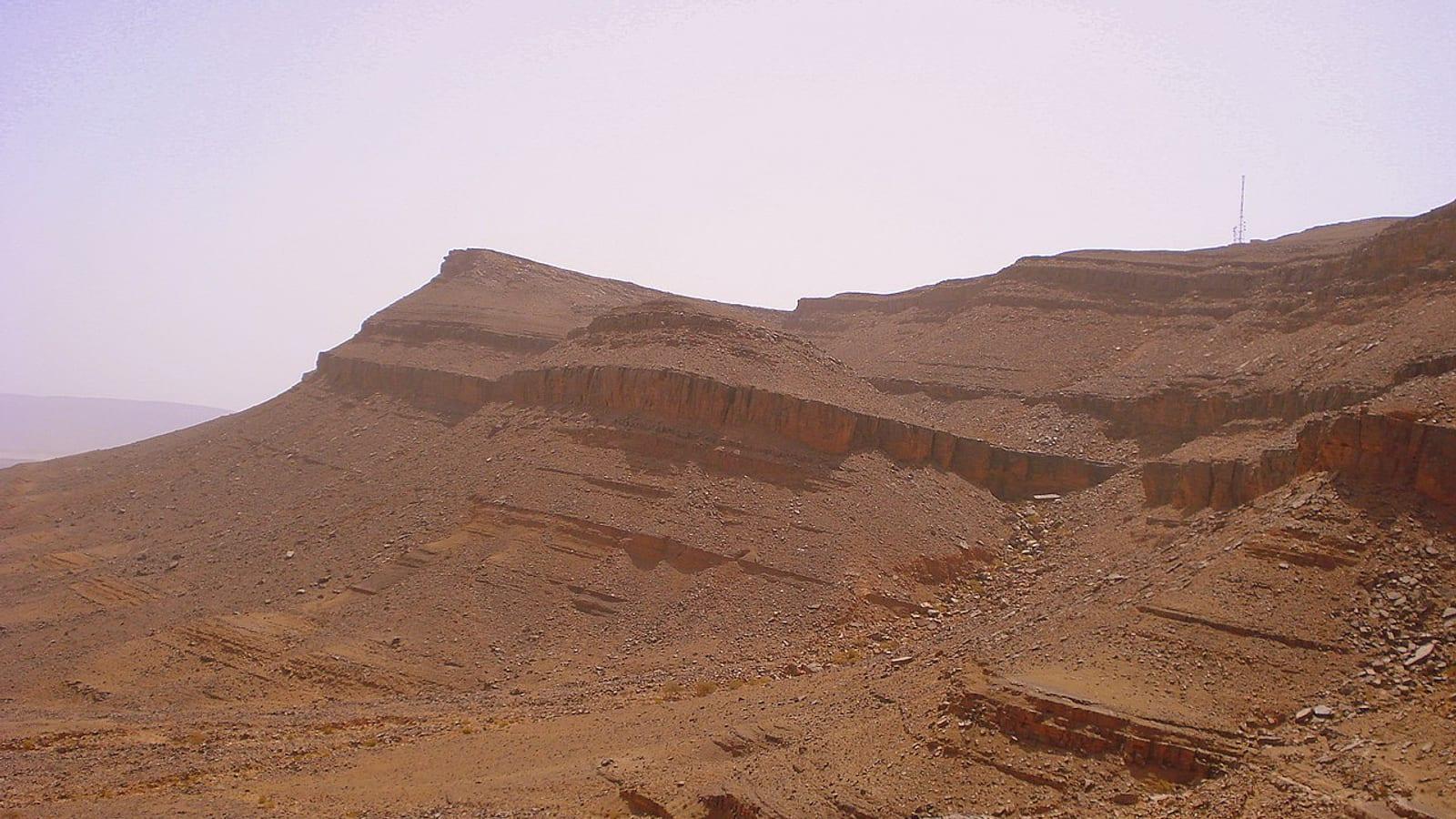
Image: hydro-xy from Zürich, Schweiz via Wikimedia Commons
Collect enrolled Ordovician trilobites at Jbel Tiskaouine near Alnif, Morocco. Flexicalymene, Colpocoryphe, and Neseuretus from the 450-million-year-old Ktaoua Formation.
At Jbel Tiskaouine, roughly 15 km southwest of Alnif, limestone beds from the Late Ordovician yield enrolled trilobites in a quantity and state of preservation that makes this mountain a benchmark for the period. The distinctive yellow-grey Ktaoua Formation here has produced tens of thousands of complete specimens over five decades, with Flexicalymene, Colpocoryphe, and Neseuretus arriving in fossil shops worldwide in their classic defensive ball posture. These animals curled themselves into a sphere roughly 450 million years ago, were buried before they could uncurl, and emerged from the rock exactly as they died. That combination of age, completeness, and posture makes Jbel Tiskaouine material instantly recognizable and genuinely collectible.
This guide explains how to reach the site from Alnif, what the Ktaoua Formation contains and why the preservation is so good, which trilobite genera you will encounter, and how the practical side of a guided visit works.
 Tamegroute-hydroxy08 (desert).jpg. Photo: hydro-xy from Zürich, Schweiz via Wikimedia Commons (CC BY-SA 2.0)
Location and Getting There
Location
Jbel Tiskaouine is located approximately 15 km southwest of Alnif in the Draa-Tafilalt Region of southeastern Morocco. The productive fossil horizons occur in yellow-grey limestone beds on the mountain's eastern slope, traceable for several hundred metres along strike. The site sits within the Anti-Atlas fold belt, where Late Ordovician sediments are exposed across a wide area. There is no postal address; access is via desert track from Alnif.
Getting There
Arrange transport and a guide in Alnif before heading to Jbel Tiskaouine. The journey takes 45 to 60 minutes via unpaved desert tracks heading southwest from town. Some sections of the track cross sand, which can be difficult without 4WD, particularly after rain or windstorms. Navigation requires local knowledge; the tracks branch and change character seasonally. Reputable guide services in Alnif include dealers near the central market and guesthouses that cater to fossil-hunting visitors. Several operators specifically mention Jbel Tiskaouine in their excursion listings. Typical excursion cost is 400 to 700 MAD (40 to 70 USD) per full day, including 4WD transport and guide.
What Fossils You'll Find
Flexicalymene is the most abundant genus at this locality. These trilobites enrolled tightly, tucking the pygidium under the cephalon to form a compact sphere. In the Ktaoua limestone, they are preserved in three dimensions and often occur in groups, consistent with mass burial during a single storm-related sediment influx event. Individual specimens range from 2 to 8 cm in enrolled diameter; larger individuals are proportionally rarer. Surface ornamentation includes fine granulation on the glabella and smooth, curved pleurae.
 Trilobite Flexicalymene by Nick Longrich.jpg. Photo: NickLongrich via Wikimedia Commons (CC BY-SA 4.0)
Colpocoryphe specimens appear in the same beds, slightly less common but often better articulated. These trilobites have a more elongate outline than Flexicalymene and shallower enrollment; the enrolled form is oval rather than spherical. The glabella tapers toward the front, and the free cheeks are comparatively broad.
Neseuretus rounds out the primary trilobite fauna. This genus has a more convex thorax than its companions, and enrolled specimens show the segmented thorax clearly visible around the equator of the ball. All three genera are members of the Calymenida order, and their co-occurrence in the same beds is a consistent feature of Late Ordovician shelf sediments across North Africa and Iberia.
Associated fossils include brachiopods, bryozoan fragments, and crinoid columnals. The brachiopods here are mostly orthid and strophomenid forms. The trilobites are the primary target, but the associated fauna adds context to what the ancient seafloor community looked like.
Geologic History
The Ancient Environment
The Ktaoua Formation at Jbel Tiskaouine was deposited during the Late Ordovician, approximately 458 to 450 million years ago (Katian stage). During this period, the region formed part of the shallow marine shelf fringing the high-latitude southern margin of the Gondwana supercontinent. Morocco lay at approximately 60° south latitude, and water temperatures were significantly cooler than the later Devonian — perhaps 10 to 20°C — with the possibility of sea ice during peak glacial intervals in the Hirnantian that immediately followed.
The yellow-grey colouration of the Ktaoua limestones reflects oxidising conditions during burial, contrasting with the anaerobic black limestones of the Devonian Erfoud Formation. Despite the cooler, higher-latitude setting, the shelf seas were biologically productive, with abundant trilobite populations living alongside brachiopods, echinoderms, and bryozoans. The frequent occurrence of enrolled trilobites in clusters points to episodic burial events — rapid sediment flows that buried animals too quickly for them to uncurl. This preservation mechanism, repeated across multiple horizons within the formation, is the direct reason that Jbel Tiskaouine produces complete, enrolled specimens rather than disarticulated fragments.
How Jbel Tiskaouine Became a Fossil Site
Mining for trilobites at Jbel Tiskaouine began in the 1970s when Berber families from Alnif discovered complete enrolled specimens weathering from the hillside. Early specimens entered the international fossil trade labelled generically as Calymene, a related but distinct genus; scientific work in the 1990s established the correct taxonomy of the Alnif enrolled fauna. The Ktaoua Formation outcrops across a wide area of the Anti-Atlas, but Jbel Tiskaouine's specific exposures have proven exceptionally productive for complete, well-preserved material. Mining has progressively moved to higher elevations as lower outcrops become depleted. Today the site is worked continuously, and the waste material from current digging regularly yields collectable loose specimens.
Visiting and Collecting Information
Access and What to Expect
All visits require hiring a local guide in Alnif and arranging access through the mining families. There is no self-guided access route. A full-day excursion costs 400 to 700 MAD depending on group size and whether 4WD rental is included. At the site you can search waste piles for loose enrolled trilobites — these are often visible as rounded grey objects in the yellow-grey rubble once you know what you are looking for. Prepared specimens at various quality levels are available for purchase from the miners directly; prices for common enrolled trilobites run from 100 to 500 MAD depending on size and completeness. Exceptional large specimens command higher prices and are typically already reserved or on their way to dealers in Erfoud.
What to Bring
Carry at least 3 litres of water per person for a full-day visit. Sun protection (hat, long sleeves, sunscreen) is essential year-round. Wear sturdy boots for the rocky hillside. A geology hammer and chisel allow you to work promising pieces of matrix from the waste pile. Wrap specimens in newspaper or bubble wrap to protect them on the rough track back to Alnif. Cash in Moroccan dirhams is the only payment method at the site.
Safety and Practical Tips
The optimal visiting window is October through April. Summer temperatures at the exposed slope regularly exceed 40°C by mid-morning, and the combination of physical exertion and reflective pale limestone amplifies the heat. In winter, night temperatures drop sharply, so plan to be back in Alnif before dark. The hillside terrain is loose scree in places; watch your footing when moving between excavated trenches. Always follow the guide's direction on which areas are safe to enter. Moroccan export regulations allow tourists to take up to 10 personal-use fossil specimens out of the country without a permit.
Sources
Nearby sites
 Bou Dib Fossil Site North Jbel Isoumour Alnif Fossil Hunting GuideBou Dib, Phacops
 Cambrian Paradoxides Site North of Alnif Fossil Hunting GuideParadoxides, Cambropallas telesto
 Jbel Isoumour Trilobite Mine Alnif Fossil Hunting GuideJbel Isoumour, Psychopyge
 Saredrar Orthoceras Quarry Tazzarine Alnif Fossil Hunting GuideSaredrar Orthoceras Quarry, Orthocerids