Seaton Sluice Northumberland Fossil Hunting Guide
Image: Derek Voller via Wikimedia Commons
Seaton Sluice in Northumberland exposes Carboniferous Coal Measures with plant fossils, corals, and bivalves visible in cliff sections along a freely accessible foreshore.
The foreshore and low cliffs at Seaton Sluice, between Whitley Bay and Blyth on the Northumberland coast, expose one of the best sequences of Westphalian B Coal Measures in Britain. The rocks here span roughly 315 to 307 million years ago, a time when Northumberland lay at equatorial latitudes in a vast coastal plain of swamps, rivers, and shallow lakes. The coal seams themselves are visible in the cliff faces, and the sedimentary rocks enclosing them contain plant remains, corals, and bivalves that record the alternating swamp and marine environments of this ancient tropical lowland. This is a site where the history of the landscape is layered vertically in the cliff face: grey-green mudstones bearing plant fossils grade into orange sandy rocks containing marine invertebrates, and thin coal seams mark the horizons where peat swamps once flourished.
The site is easily accessed from the car park at Hartley, south of Seaton Sluice village, and the foreshore walk northward along the base of the cliffs is straightforward at low tide. This guide covers the approach, the fossil types and their positions in the sequence, the geological history of the site, and the rules for collecting here.
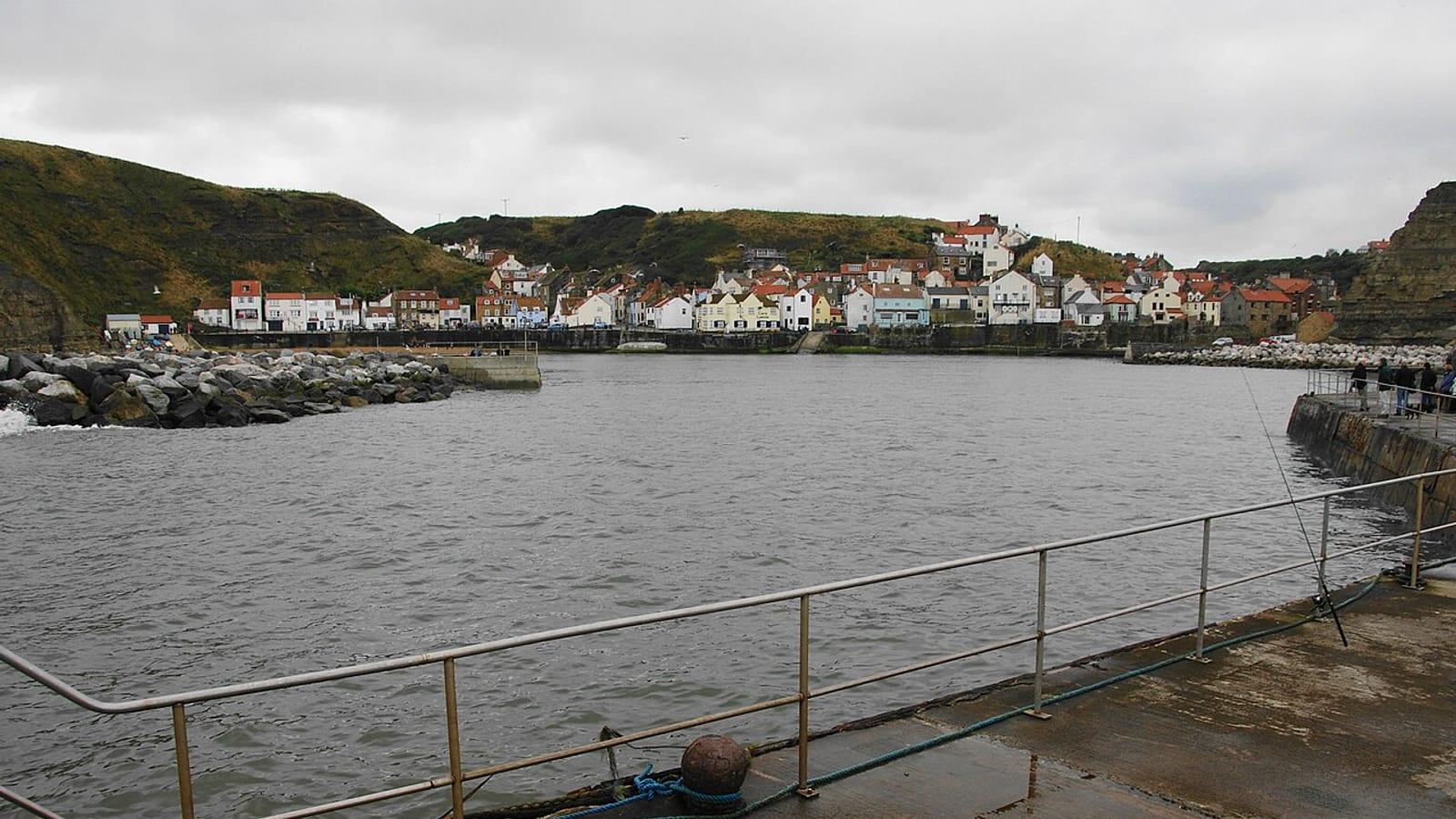
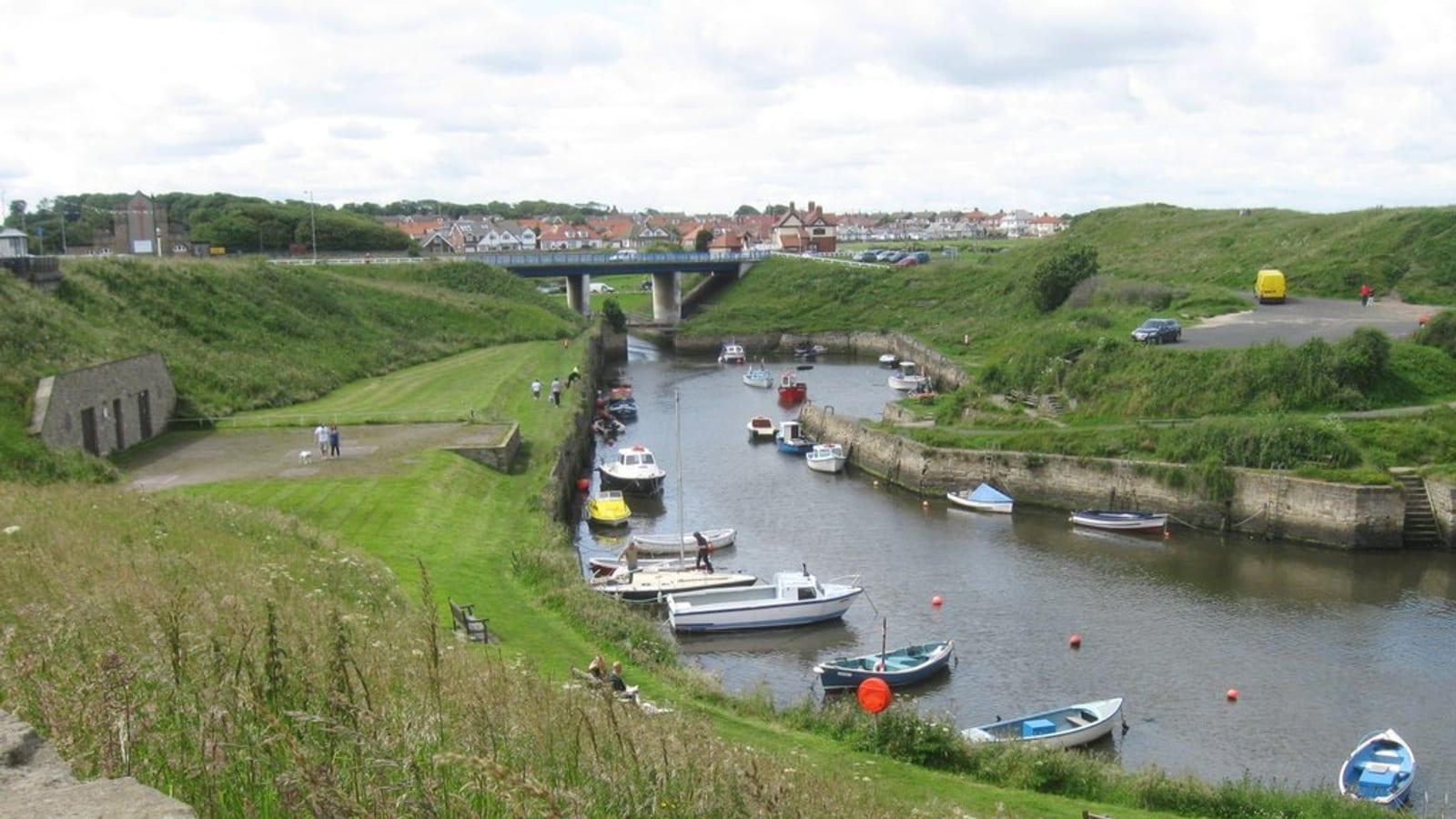
 Seaton Sluice Harbour, Northumberland - geograph.org.uk - 3069982.jpg. Photo: Derek Voller via Wikimedia Commons (CC BY-SA 2.0)
Location and Directions
Address
Hartley Bay foreshore and cliffs, Seaton Sluice, Northumberland NE26. The site is accessed from the car park at Hartley, just south of Seaton Sluice village.
Directions and Parking
From the A19, take the A186 exit toward Whitley Bay and then follow signs toward Seaton Sluice along the A193. The car park at Hartley is situated on the coast road just south of Seaton Sluice village, before the road crosses the harbour. Parking is available along the seafront and in the small car park adjacent to the beach access. From the car park, descend to the beach via the steps cut into the sea wall. Walk northward along the foreshore, keeping the cliffs on your left. The Carboniferous exposures begin within a few hundred metres and continue northward along the base of the cliffs. The site lies north of St Mary's Island lighthouse when viewed from the sea. Tide is a significant constraint here: check tide times for the Tyne (Newcastle upon Tyne is the nearest reference point) and plan to be on the foreshore during the two hours either side of low water for the best access to the cliff base.
What Fossils You'll Find
Plant remains are the most consistently found fossils at Seaton Sluice. They occur primarily in the grey-green mudstones and siltstones that represent ancient swamp and floodplain deposits. Lycopod bark impressions (from giant clubmoss trees such as Lepidodendron and Sigillaria) are recognisable by their distinctive diamond or oval leaf-scar patterns. Fern fronds, horsetail stems, and seed-plant foliage also occur. Look for flat slabs of mudstone with impressions on the bedding surfaces; splitting mudstone along bedding planes is the most productive approach. The plant material can be fragile once exposed to air, so wrap specimens promptly.
 The fossils from Cretaceous age found in Lebanon.jpg. Photo: Brocken Inaglory via Wikimedia Commons (CC BY-SA 3.0)
Coal is visible as thin black seams in the cliff face and as loose black fragments on the beach. It is not a collectable in the traditional sense, but recognising it helps you orientate yourself in the sequence: marine fossils tend to occur in the sandier orange-brown layers immediately above or below the coal, while plant fossils are concentrated in the grey mudstones associated with the coal horizon.
Corals occur in the marine limestone and sandstone bands intercalated within the Coal Measures. These represent brief marine incursions when the sea flooded the coastal plain. Solitary rugose corals and small colonial forms have been recorded. They are less common than the plant material but are worth looking for in the lighter-coloured, harder limestone bands.
Bivalves are present in both the marine bands and in the freshwater mudstone horizons. Non-marine (freshwater) bivalves are small and often occur in dense accumulations within specific mudstone beds. Marine bivalves from the incursion horizons are larger and more varied. Both types are useful for confirming the identity of specific beds in the sequence.
Geologic History
The Ancient Environment
The Seaton Sluice Coal Measures belong to the Westphalian B stage of the Upper Carboniferous, approximately 315 to 307 million years ago. During this interval, Northumberland was positioned at or very close to the equator, in a low-relief coastal plain drained by braided rivers and covered by vast swamp forests dominated by lycopsid trees reaching heights of 30 metres or more. The sequence exposed at Seaton Sluice is approximately 115 m thick and shows repeated coarsening-upward cycles: each cycle begins with offshore marine or lagoonal mudstones at the base and grades upward through siltstone and sandstone deposited by rivers, before culminating in swamp peats that eventually became coal. These cycles reflect the repeated advance and retreat of the sea across the low-lying coal plain, driven by long-term changes in sea level and sediment supply. The grey-green colour of the non-marine mudstones reflects reducing conditions in swampy ground, while the orange-brown colour of the marine sandstones reflects different chemical conditions during deposition and subsequent weathering. The peat layers, compressed and transformed by burial to form coal, are the accumulated organic matter of billions of swamp trees that died and were preserved in anaerobic waterlogged conditions rather than being decomposed.
How Seaton Sluice Became a Fossil Collecting Site
The Coal Measures at Seaton Sluice were actively mined in the area for several centuries as part of the northeast England coalfield, one of the most economically significant coalfields in Britain. The Delaval family developed the harbour at Seaton Sluice in the seventeenth century specifically to export coal from the surrounding pits. At its peak in the eighteenth and nineteenth centuries, more than thirty pits operated around Hartley township, and the 1862 Hartley Colliery disaster, in which 204 men and boys lost their lives when the winding gear fell into the single shaft, directly led to legislation requiring all mines to have two shafts. Today, the coastal cliff section at Seaton Sluice exposes these same Coal Measures at the surface, where wave action and frost shattering continuously erode the cliff face and release fossils onto the foreshore. The site is now considered one of the best accessible Coal Measures sections in Britain for both geological study and amateur fossil collecting.
Collecting Rules and Regulations
Is Fossil Collecting Allowed?
The foreshore at Seaton Sluice is public land accessible under standard foreshore rights. Fossil collecting from loose material on the beach is freely permitted. The cliff face should not be undercut or climbed, and you should not attempt to dig into the cliff base or hammer directly into in-situ exposures at the cliff face. If specific sections of the cliffs fall within an SSSI, Natural England's standard guidance on responsible surface collecting applies. The foreshore is managed by Northumberland County Council and is subject to normal beach access rules.
Recommended Tools
A geological hammer and chisels for splitting mudstone slabs along bedding planes are the most useful tools here. The mudstone splits readily and plant fossils are often revealed on fresh bedding surfaces. Bring a stiff brush for cleaning specimens, a hand lens for examining plant scar detail, and padded wrapping for fragile plant material. Waterproof boots are essential as the foreshore rocks are often covered in seaweed and pools.
Safety
The cliffs at Seaton Sluice are actively eroding and can shed material onto the foreshore at any time. Do not stand beneath the cliff faces, particularly after wet or cold weather. The foreshore is tidal: the best collecting window is the two hours either side of low water, and you must be aware of the returning tide, which can move quickly along this stretch of coast. Do not allow children to work close to the cliff base unsupervised. The foreshore rocks are slippery, particularly where covered by green algae.