Porcupine Gorge National Park Fossils Fossil Hunting Guide
Image: ElPhantomero via Wikimedia Commons
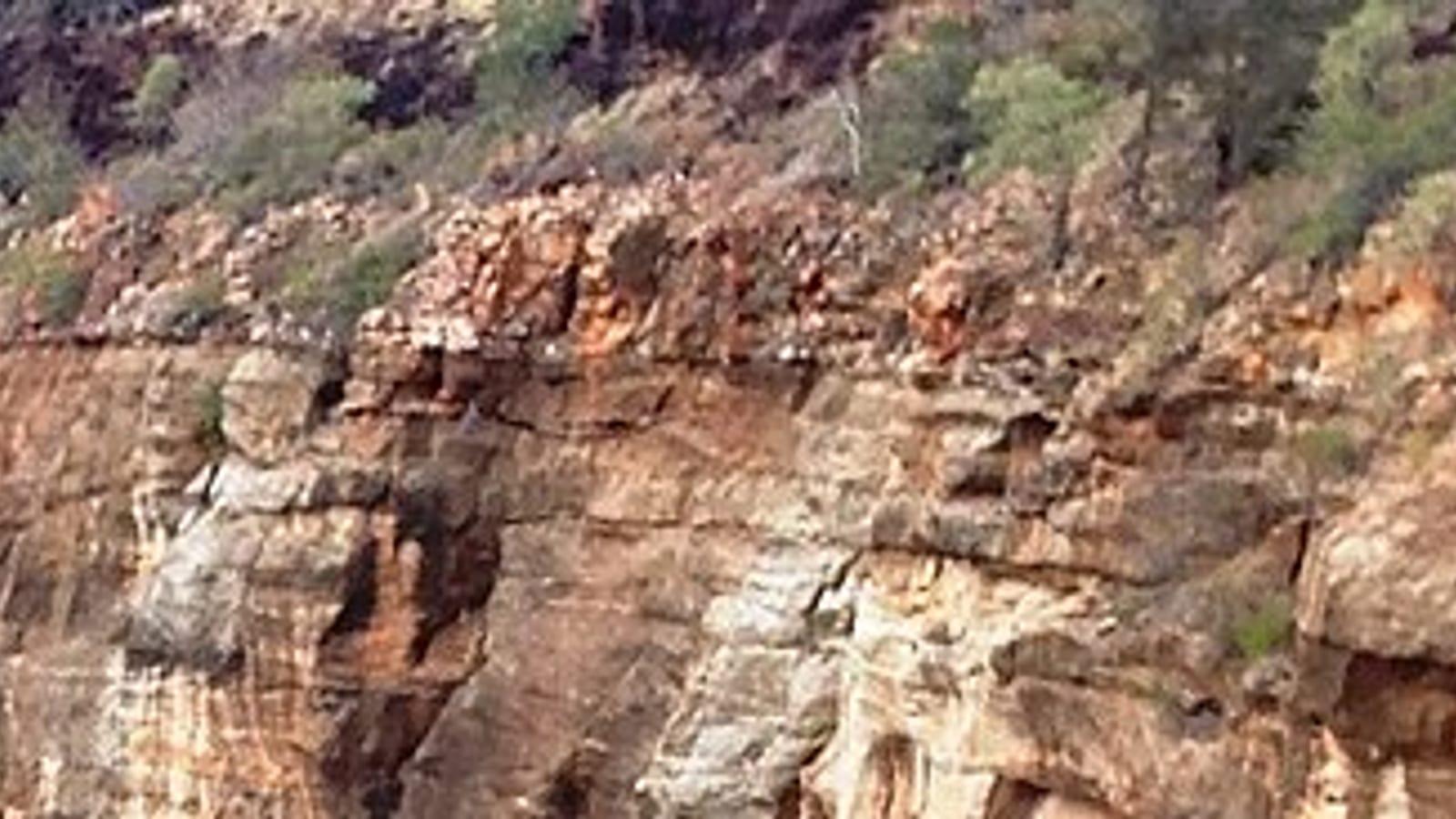
Porcupine Gorge National Park exposes 500 million years of rock near Hughenden, QLD, including in-situ Permian Glossopteris fossil leaves visible in the gorge walls.
Porcupine Gorge National Park sits 60 kilometres north of Hughenden in outback Queensland, and its walls hold something few places on Earth can match: a continuous cross-section of sedimentary rock spanning roughly 500 million years of geological history. The creek that carved this gorge did not simply expose rock — it cut through time, layer by layer, revealing ancient seafloors, river deltas, and coal-forming swamps in a single cliff face. Within those lower Permian layers, visitors can see Glossopteris fossil leaves preserved in mudstone, tangible evidence that this sunbaked inland plain was once a cool, forested swamp at the edge of Gondwana. Fossilised wood also occurs within the gorge walls.
The gorge descends approximately 120 metres from rim to floor and stretches for several kilometres. At its heart stands the Pyramid, a multicoloured sandstone monolith that gives the camping area its name. The gorge is often called Australia's Little Grand Canyon, a comparison earned by its towering banded cliffs rather than its scale. This guide covers how to reach the gorge, what geological and fossil features you will find, the permit rules that apply, and what to bring for a safe visit.
 Porcupine Gorge National Park, Queensland banner.jpg. Photo: ElPhantomero via Wikimedia Commons (CC BY-SA 4.0)
Location and Directions
Address
Porcupine Gorge National Park, Kennedy Development Road, Flinders Shire, Queensland 4825. The Pyramid camping area and main access tracks are located approximately 60 kilometres north of Hughenden.
Directions
From Hughenden, drive north along the sealed Kennedy Development Road for approximately 57 kilometres. Turn left onto the unsealed Porcupine Gorge Road, which is clearly signposted. The car park for the gorge rim lookout is reached within a few kilometres of this turn. A second access track leads to the Pyramid camping area at the gorge floor. The descent track is steep — allow around 45 minutes each way and wear appropriate footwear. Four-wheel drive is not required for the main car park, though the road to the camping area may become impassable after heavy rain. Fuel and supplies are available in Hughenden before departure; there are no facilities along the route.
Parking at the gorge rim lookout is free. The camping area has a small car park adjacent to the Pyramid. Check current road conditions with Queensland Parks and Wildlife Service before travelling, particularly in summer when tropical storms can affect access roads.
What Fossils You'll Find
Porcupine Gorge is primarily a geological site rather than a dedicated fossil locality, but in-situ fossil material is present within the exposed rock layers and is visible to observant visitors who know what to look for.
 Glossopteris sp. (fossil leaf) (Permian; Antarctica) 1 (49063572172).jpg. Photo: James St. John via Wikimedia Commons (CC BY 2.0)
Glossopteris leaves are the most accessible fossils here. These tongue-shaped leaf impressions appear in the Permian mudstone beds within the lower gorge walls. Glossopteris was a seed fern that dominated Gondwanan landscapes during the Permian period, and its presence in these beds was one of the early clues that helped geologists reconstruct the supercontinent. The leaves are typically preserved as dark carbonaceous films on the surface of split mudstone. You will not remove them — collecting is prohibited in the national park — but you can examine the rock faces carefully at gorge level and spot leaf outlines and vein patterns clearly.
Fossilised wood also occurs within the gorge, preserved as silicified fragments within sandstone horizons. These pieces show original cellular structure replaced by silica and appear brownish against the surrounding pale sandstone.
The gorge walls also expose evidence of ancient geological processes that are themselves of scientific interest: a normal fault cutting through sandstone units, sedimentary load structures, and distinct coal seam layers intercalated with siltstone and mudstone. While not fossils in the biological sense, these features form part of the same Permian swamp record as the Glossopteris leaves.
The upper gorge layers are younger and contain no significant fossil material, but they display dramatic cross-bedding and colour banding that reflects changing depositional environments across hundreds of millions of years.
Geologic History
The Ancient Environment
The rocks exposed in Porcupine Gorge record environments ranging in age from approximately 500 million years (Cambrian period) at the deepest exposed levels to roughly 5 million years in the uppermost units. No single formation spans this entire range; the sequence represents multiple separate depositional episodes separated by unconformities.
The fossil-bearing Permian layers date to approximately 280 to 300 million years ago, during the late Carboniferous to early Permian period. At this time Australia formed part of the supercontinent Gondwana and was positioned much closer to the South Pole than it is today. The climate was cool to cold temperate, and vast coal-forming swamps covered large areas of what is now inland Queensland. Glossopteris and related seed ferns dominated these swamp forests. As plant material accumulated and was buried under subsequent sediments, it was compressed into the coal seams still visible within the gorge walls today. The fine-grained mudstone layers interbedded with the coal preserve the leaf fossils.
Younger sedimentary layers record a transition from these Permian swamp environments to Mesozoic river systems and eventually to the semi-arid conditions that characterise the region today.
How Porcupine Gorge Became a Fossil Viewing Site
Porcupine Creek began cutting its gorge through the sedimentary sequence as regional uplift gradually elevated the landscape. Over millions of years, the creek eroded downward through successive rock layers, exposing progressively older formations. This process continues today: each wet season, floodwaters carry sediment downstream and cut the gorge walls slightly deeper, occasionally revealing fresh rock surfaces. The result is a living geological cross-section where different time periods are stacked visibly above one another. Queensland Parks and Wildlife Service gazetted the area as a national park to protect both its geological heritage and its biodiversity values. No quarrying or industrial disturbance has altered the natural exposure sequence.
Visiting Rules and Regulations
Is Fossil Collecting Allowed?
Fossil collecting and the removal of any geological material are prohibited under the Queensland Nature Conservation Act 1992 and the Nature Conservation (Protected Areas) Management Regulation. Porcupine Gorge is a Class B protected area managed for conservation. Visitors may observe and photograph in-situ fossils and geological features. Scientific research within the park requires a permit from Queensland Parks and Wildlife Service. Violations carry significant penalties.
Recommended Equipment
The descent to the gorge floor is steep and the track is unformed in places. Wear sturdy closed-toe shoes or hiking boots with ankle support. Bring at least two litres of water per person for a half-day visit — the gorge floor is significantly hotter than the rim during summer. A hand lens or magnifying glass will help you examine Glossopteris leaf impressions more closely in the mudstone beds. Sunscreen and a wide-brimmed hat are essential. A topographic map or downloaded GPS track of the Pyramid walking track is useful; the descent is not always clearly marked on the ground.
Safety
Porcupine Gorge sits in remote outback Queensland. The nearest hospital is in Hughenden, 60 kilometres south. Summer temperatures regularly exceed 40°C; avoid the gorge descent during the middle of the day between November and March. The gorge floor can flash flood during and after rain — do not descend if storms are visible or forecast within the catchment area. Snakes, including eastern browns and taipans, are present in the gorge environment; watch where you place your hands and feet on rocky surfaces. Mobile phone coverage is limited in the gorge and along much of the Kennedy Development Road. Inform someone of your planned itinerary before departing Hughenden.
Sources
- https://parks.des.qld.gov.au/parks/porcupine-gorge
- https://www.nprsr.qld.gov.au/parks/porcupine-gorge/about.html
- https://www.business.qld.gov.au/industries/farms-fishing-forestry/agriculture/land/soil-land-use/queensland-geology
- https://en.wikipedia.org/wiki/Porcupine\_Gorge\_National\_Park
- https://en.wikipedia.org/wiki/Glossopteris
- https://www.dinosaurtrail.com.au/porcupine-gorge
Nearby sites
 Kronosaurus Korner Queensland Fossil Museum Fossil Hunting GuideEromanga Sea, Kronosaurus queenslandicus
 Australian Age of Dinosaurs Museum Winton Fossil Hunting GuideAustralian Age of Dinosaurs Museum, Diamantinasaurus matildae
 Mount Etna Caves National Park Fossil Hunting GuidePleistocene fossil assemblage, Invictokoala monticola
 Chinchilla Fossil Museum Queensland Fossil Hunting GuideChinchilla Sand, Varanus komodoensis