Nusplingen Plattenkalk Museum Fossil Klopfplatz Fossil Hunting Guide
Image: Olga Ernst via Wikimedia Commons
Visit Nusplingen museum showcasing angel sharks and pterosaurs from a Kimmeridgian lagerstätte, then try the fossil Klopfplatz in Baden-Württemberg's Zollernalb.
The Nusplingen Plattenkalk is one of the world's exceptional Jurassic fossil deposits, comparable in preservation quality to the famous Solnhofen beds 300 km to the east but producing a distinct fauna that includes complete angel sharks with skin texture preserved, pterosaurs with wing membrane impressions, and the oldest known centipede, Eogeophilus dunlopi. The limestone was first scientifically described in 1839, and systematic scientific excavations by the Stuttgart Natural History Museum have been running continuously since 1993. In 2009, a purpose-built museum opened in Nusplingen village to display the most significant finds and explain the unique preservation conditions of this Kimmeridgian-age lagerstätte.
The site is primarily a scientific research locality and museum destination. A public Klopfplatz exists alongside the museum, offering limited fossil collecting in limestone material under controlled conditions. Access to the scientific excavation areas is restricted to research teams. This guide covers how to plan a visit, what the museum displays and what the Klopfplatz offers, the geology of the Nusplingen Plattenkalk, and the practical details of getting there. Whether you come primarily for the museum or hope to try the Klopfplatz, Nusplingen rewards the journey.
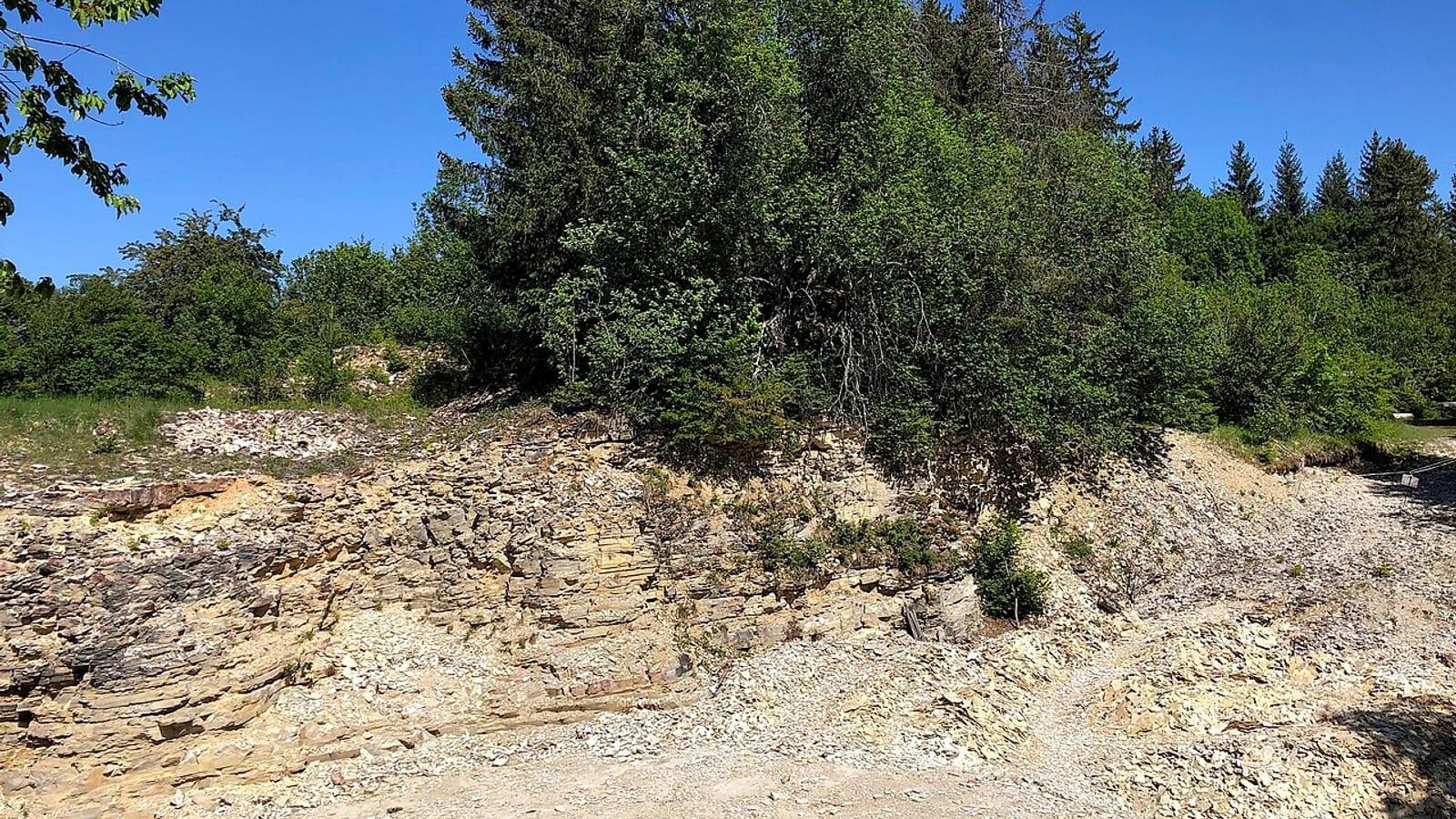
 Plattenkalk-Steinbruch, Naturschutzgebiet Westerberg, Nusplingen.jpg. Photo: Olga Ernst via Wikimedia Commons (CC BY-SA 4.0)
Location and Directions
Address
Museum Nusplingen (Fossilienmuseum Nusplingen), Saurierweg 1, 72362 Nusplingen, Zollernalbkreis, Baden-Württemberg, Germany.
Directions
From Stuttgart, take the A81 south toward Rottweil, exit at Oberndorf/Sulz (exit 33), then follow the B462 south toward Schramberg and then local roads east through Schömberg to Nusplingen. Total distance is approximately 105 km; allow around 85 minutes. Alternatively, take the A81 south, exit at Rottweil, then follow local roads north and east via Schömberg to Nusplingen.
From Tübingen, take the B27 south toward Balingen, then continue on local roads southwest to Nusplingen via Schömberg. Total distance is approximately 60 km; allow around 55 minutes.
From Freiburg, take the A81 north, exit at Rottweil, then follow local roads to Nusplingen via Schömberg. Total distance is approximately 130 km; allow around 105 minutes.
Nusplingen is a small village in the Zollernalb; follow the brown tourism signs for the Fossilienmuseum from the outskirts of the village. Parking is available at the museum. The nearest train station is Balingen, approximately 25 km to the northeast, from which taxis are available.
What Fossils You'll Find
The Nusplingen Plattenkalk has yielded one of the most diverse and best-preserved Upper Jurassic faunas known anywhere in the world. The museum displays represent what scientific excavations have recovered since 1993; the Klopfplatz gives visitors the chance to find common material from the same formation.
 Nusplinger Plattenkalk Grube F. A. Quenstedt 2013-08-20.jpg. Photo: LepoRello via Wikimedia Commons (CC BY-SA 3.0)
Angel sharks (Pseudorhina acanthoderma) are the signature discovery of the Nusplingen excavations. Multiple specimens have been recovered showing not just skeletal material but dermal denticles, skin texture, and body outline. They are displayed in the museum and represent a level of preservation that was unexpected when excavations began.
Ammonites are the most commonly found fossils in accessible Klopfplatz material. They occur as flattened internal moulds and occasionally with shell material intact. Several species representing the Kimmeridgian ammonite fauna of the South German Shelf are present.
Fish are found regularly in productive Plattenkalk horizons. Pycnodont fish with rounded crushing teeth, ray-finned fish with articulated skeletons, and actinopterygian species are all on record from the formation. Complete articulated specimens occasionally appear in material supplied to the Klopfplatz, though they are uncommon compared to isolated bones and scales.
Shrimp and crustaceans occur in the limestone. Complete caridean shrimp with preserved appendage detail have been recovered in scientific excavations. Klopfplatz material may yield fragments and partial specimens.
Pterosaur bones have been found in the scientific excavations, including material that preserves impressions of wing membrane (Rhamphorhynchus-type forms). These are not Klopfplatz material but are displayed in the museum.
The centipede Eogeophilus dunlopi, described from Nusplingen material and long considered among the oldest known myriapods, is a landmark specimen in the museum's collection, representing the extraordinary range of the deposit beyond purely marine fauna.
Geologic History
The Ancient Environment
During the Kimmeridgian Stage of the Late Jurassic, approximately 154 million years ago, the area now forming the Swabian Alb of Baden-Württemberg lay within a shallow carbonate platform sea in the western Tethys realm. Warm subtropical conditions prevailed, with sea surface temperatures around 22–26°C and no significant polar ice. The landscape was a complex of reef structures, shallow platform areas, and restricted inter-platform depressions.
The Nusplingen Plattenkalk records one of those restricted depressions, a basin within the carbonate platform where water circulation was limited and the bottom became periodically anoxic. The combination of isolation, anoxia, and fine carbonate sedimentation produced the conditions for exceptional preservation. Organisms that fell to the basin floor, whether swimmers that died in the water column above, or terrestrial and semi-terrestrial animals like pterosaurs and centipedes washed or blown in from nearby land surfaces, were entombed in calcareous ooze that preserved anatomical detail at a cellular level in some cases.
The rock is a micritic plattenkalk: dense, fine-grained, pale grey limestone that splits cleanly along thin bedding planes. After deposition in the Kimmeridgian, the sediments were progressively buried under younger Jurassic and Cretaceous material, lithified, and uplifted during the Alpine orogeny. Erosion in the Zollernalb district eventually brought the formation to the surface.
How Nusplingen Plattenkalk Became a Fossil Collecting Site
The Nusplingen Plattenkalk was first brought to scientific attention in 1839 when Friedrich August von Quenstedt visited a local quarry after being shown specimens by village physician Friedrich Kinzelbach. Quenstedt's publication established the scientific significance of the deposit and initiated the long history of academic interest in the Nusplingen fauna.
During the mid-nineteenth century, prominent figures including Bishop Oskar Fraas collected extensively from Nusplingen and assembled specimens that entered major German natural history collections. The quarry also produced floor tiles and was briefly evaluated as a source of lithographic stone, but the stone proved unsuitable for printing and the site was not commercially exploited on a large scale.
In 1983, the Stuttgart Natural History Museum (Staatliches Museum für Naturkunde Stuttgart, SMNS) successfully had the deposit legally protected, recognising its exceptional scientific value. Systematic scientific excavations began in the 1993–1994 season and have continued under SMNS direction, recovering spectacular specimens including the angel sharks, pterosaurs, and Eogeophilus. The museum in Nusplingen village opened in 2009 specifically to house and display locally recovered specimens and to provide educational interpretation of the site. The Klopfplatz was established to give visitors a hands-on connection to the formation while protecting the scientifically important excavation areas from unsupervised access.
Collecting Rules and Regulations
Is Fossil Collecting Allowed?
Fossil collecting at Nusplingen is available through the Klopfplatz, which operates alongside the museum. Museum admission is required. Access to the Klopfplatz and the availability of fresh collecting material are subject to change and should be confirmed in advance by contacting the museum directly.
Museum admission is typically €5–7 for adults and reduced rates for children. The Klopfplatz provides controlled quantities of Nusplingen Plattenkalk for splitting. Common finds include ammonites and small invertebrate fossils. The scientific excavation areas are strictly off-limits to the public at all times.
Contact the museum before travelling to confirm Klopfplatz availability: +49 7429 913348, www.museum-nusplingen.de. Guided tours are available and are recommended for understanding the site's geological context.
In accordance with Baden-Württemberg natural heritage law (NatSchG BW), significant vertebrate finds must be reported to the relevant authority (Regierungspräsidium Freiburg, Referat Denkmalpflege und Geologie). The museum staff can advise on this process.
Recommended Tools
The museum and Klopfplatz may provide basic splitting tools; confirm when booking. If you bring your own: a lightweight rock hammer (250–350 g) and a thin flat chisel are the appropriate tools for plattenkalk, which splits along thin bedding planes without heavy blows. Safety glasses are essential. A soft brush and a container with soft lining for transporting specimens complete the kit. The plattenkalk is more fragile than many collecting substrates; work slowly and use thin wedges to open slabs rather than direct hammer blows on the surface.
Safety
The Klopfplatz is a managed area. Follow all instructions from museum staff. Safety glasses are non-negotiable when splitting limestone. Supervise children at all times. The site involves an outdoor area with uneven ground and split rock surfaces; wear closed-toe shoes. Do not enter the scientific excavation areas under any circumstances.
Sources
- https://www.museum-nusplingen.de
- https://www.smns-bw.de (Staatliches Museum für Naturkunde Stuttgart — Nusplingen research programme)
- https://doi.org/10.1127/0044-2798/2015/0054 (Schweigert, 2015 — Nusplingen Plattenkalk overview in Zitteliana)
- https://en.wikipedia.org/wiki/Nusplingen\_Plattenkalk (general context; cross-referenced with Schweigert 2015)
- https://www.lgrb-bw.de
Nearby sites
 Werkforum Dotternhausen Fossil Hunting GuideSafety Guidelines, Sources
 Schiefererlebnis Dormettingen Fossil Klopfplatz Fossil Hunting GuidePosidonia Shale, Toarcian Stage
 Urweltsteinbruch Holzmaden Posidonia Shale Fossil Hunting Guidefossil retail shop, Urwelt-Museum Hauff
 Ries Crater Nordlingen Meteorite Impact Geopark Fossil Hunting Guidesuevite impact breccia, RiesKrater Museum