Mungo National Park Fossil Hunting Guide
Image: Richard Horvath via Wikimedia Commons
Mungo National Park in NSW holds the world's oldest cremation at 42,000 years, 457 Pleistocene footprints, and megafauna fossils viewable on guided tours of the Walls of China lunette.
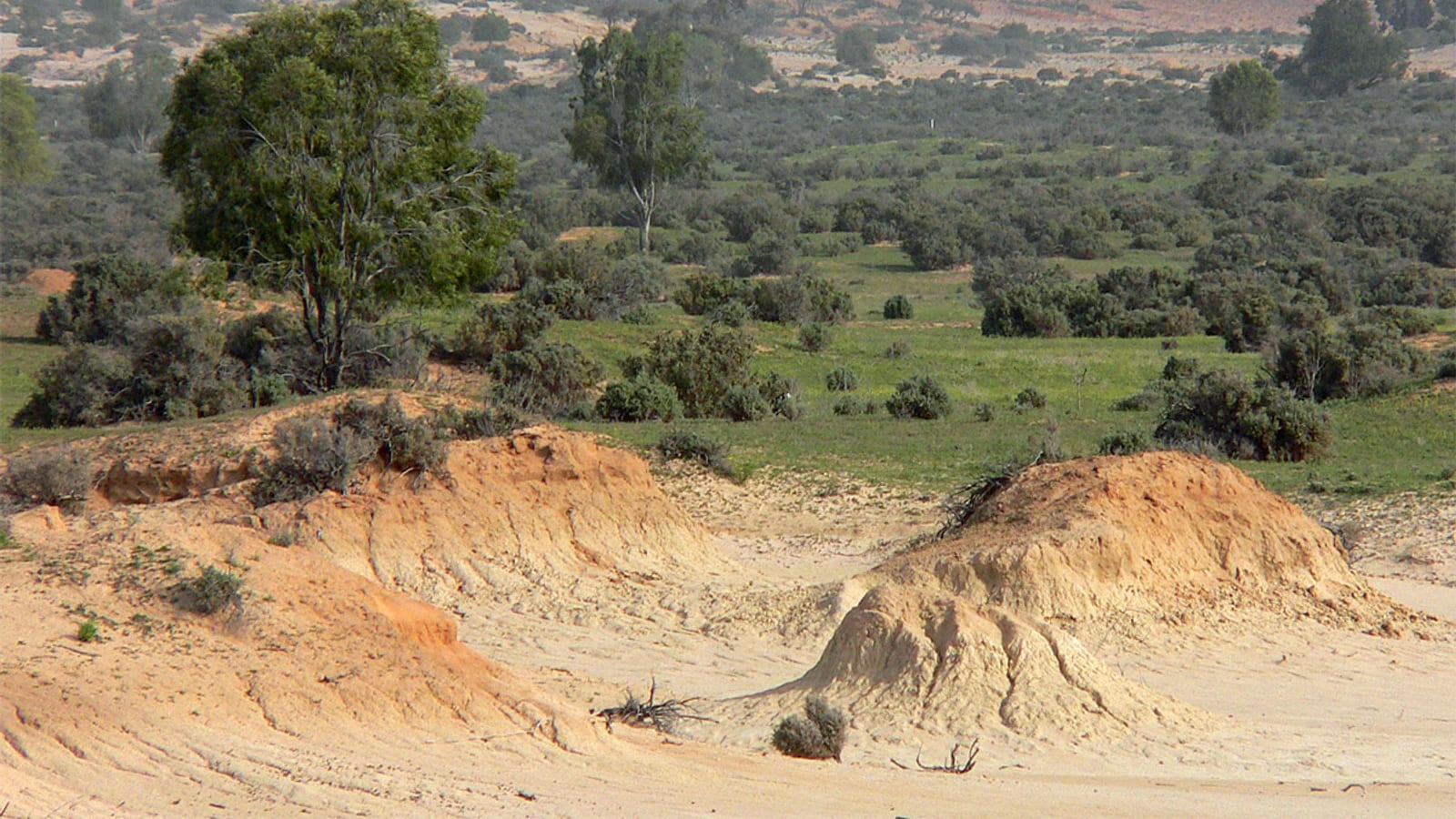
Mungo National Park holds evidence of human presence stretching back at least 50,000 years. The Walls of China — a 30-kilometre lunette of pale clay and sand sculpted by wind erosion across the bed of a long-dried lake — have yielded two of the most significant archaeological discoveries ever made in the Southern Hemisphere. Mungo Lady, discovered in 1968, represents the world's oldest known cremation at approximately 40,000 to 42,000 years ago. Mungo Man, found in 1974, is among the earliest anatomically modern human remains in the world. Both burials, separated by only a few metres, demonstrate the sophistication of human ceremony at a time when ice sheets still covered much of the northern hemisphere.
Alongside the human evidence, the same sediment sequences have yielded Pleistocene megafauna including the giant marsupial Zygomaturus trilobus, the mihirung bird Genyornis newtoni, and thylacine material. In 2003, a field of 457 fossilised human footprints was discovered nearby — the largest assemblage of Pleistocene human tracks in the world. This guide covers how to reach Mungo, the guided tour options, what is visible during a visit, and the rules that protect this World Heritage site.
 Lake Mungo Lunettes - panoramio.jpg. Photo: Richard Horvath via Wikimedia Commons (CC BY-SA 3.0)
Location and Directions
Address
Mungo National Park Visitor Centre, Arumpo Road, Mungo NSW 2715. The park is located in the far southwest of New South Wales, in the Willandra Lakes region.
Directions
From Mildura (Victoria), head north across the Murray River bridge and turn east onto the Silver City Highway, then follow signs to Wentworth and north to Pooncarie on the Darling River Road. From Pooncarie, head west on Arumpo Road approximately 90 km to the park. This is the most direct route from the nearest major centre — total distance from Mildura is approximately 110 km but road conditions vary significantly. The road from Pooncarie to the park is largely unsealed. Check road conditions with the NSW National Parks Information Centre before travelling, as the road becomes impassable after heavy rain.
Alternatively, from Mildura take the Sturt Highway east to Buronga, then follow the tourist route signage north via Wentworth and east via Pooncarie. From Sydney, the park is approximately 900 km to the southwest — allow at least 10 hours driving via Wagga Wagga and Hay, or via Dubbo and Broken Hill. A 4WD vehicle is strongly recommended, particularly in wet conditions. Fuel is available at Pooncarie (petrol only) and at Menindee — do not attempt the drive to Mungo without a full tank.
Parking is available at the Visitor Centre near the former Mungo woolshed. Day visitor parking is free with a valid NSW National Parks Pass or by paying the day-use fee at the self-registration station.
What Fossils You'll Find
Mungo National Park is primarily an archaeological site, but the same sediment sequences that preserve human remains also contain Pleistocene vertebrate fauna. The fossils are not collected by visitors — they are observed in situ during guided tours, where trained guides point out evidence exposed by ongoing wind erosion of the Walls of China lunette.
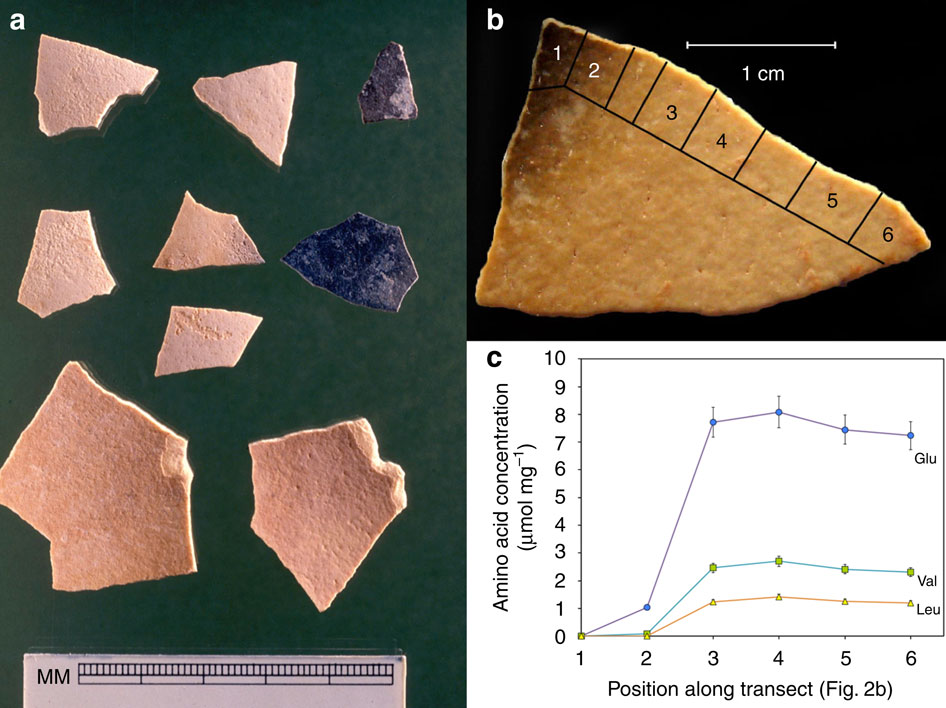 Ncomms10496-f2.jpg. Photo: Miller, Gifford; Magee, John; Smith, Mike; Spooner, Nigel; Baynes, Alexander; Lehman, Scott; Fogel, Marilyn; Johnston, Harvey; Williams, Doug; Clark, Peter; Florian, Christopher; Holst, Richard & DeVogel, Stephen via Wikimedia Commons (CC BY 4.0)
Zygomaturus trilobus was a large, semi-aquatic marsupial distantly related to wombats, roughly the size of a small hippopotamus. Tooth and bone fragments have been recovered from Mungo sediments and are dated to the period of lake activity, before the lakes dried approximately 18,500 to 14,000 years ago.
Genyornis newtoni, the mihirung or giant thunderbird, was a large flightless bird standing approximately 2 metres tall and weighing over 200 kg. Its eggshell fragments have been found across the Willandra Lakes region, and the species' extinction coincides with the period of human arrival, though the precise cause is debated among researchers.
Thylacinus cynocephalus (the thylacine or Tasmanian tiger) material from Mungo demonstrates that this species had a much broader distribution across the continent during the Pleistocene before its mainland extinction, which preceded the European period by several thousand years.
The 457 fossilised human footprints discovered in 2003 at a site approximately 6 km from the main Walls of China track are dated to approximately 19,000 to 23,000 years ago. These represent men, women, and children moving across a claypan — one set of tracks suggests a one-legged individual moving at speed, possibly using a crutch. The footprint site is not on the standard visitor route and access is by special arrangement through the park.
Geologic History
The Ancient Environment
The Willandra Lakes system is a chain of 17 interconnected lakes fed by the Willandra Creek, a distributary of the Lachlan River. The geological record preserved in the Mungo sediment sequence spans approximately 50,000 to 14,000 years before present, covering the late Pleistocene Epoch. At its maximum, Lake Mungo held fresh water to a depth of approximately 15 metres and covered around 1,000 square kilometres. The lake supported a productive aquatic ecosystem including freshwater fish (predominantly golden perch and Murray cod), crustaceans, and water birds. Aboriginal people fished the lake and gathered shellfish from its shores — the evidence is preserved in shell middens around the lake perimeter and in the form of fish bones and freshwater mussel shells distributed through the archaeological layers.
The lake began declining around 25,000 years ago as the climate became progressively drier and the Willandra Creek's flow reduced. By approximately 18,500 years ago the lake was dry. Wind then began reworking the exposed lake sediment, building the Walls of China lunette on the eastern shore from material carried by westerly winds. The three stratigraphic units visible in the Walls of China — the Golgol, Mungo, and Arumpo layers — represent distinct periods of lake activity and drying, each preserving different records of the environment and its inhabitants.
How Mungo National Park Became a Fossil and Heritage Viewing Site
The significance of Mungo was first brought to scientific attention by geologist Jim Bowler, who recognised the stratigraphic complexity of the Walls of China during geological fieldwork in the 1960s. Bowler discovered the Mungo Lady burial in 1968 and directed archaeologists to the Mungo Man burial in 1974. UNESCO inscribed the Willandra Lakes region as a World Heritage site in 1981, recognising its outstanding universal value for both human evolution and natural heritage. The site is jointly managed by NSW National Parks and Wildlife Service and the three Traditional Custodian groups: the Ngyiampaa, Mutthi Mutthi, and Paakantyi peoples. Ongoing erosion of the Walls of China continues to expose new material, including additional human remains and megafauna fossils, which are reported to the joint management team and assessed for protection or scientific study.
Visiting Rules and Regulations
Is Fossil Collecting Allowed?
No collecting of any kind is permitted. Mungo National Park is a UNESCO World Heritage Site managed under a joint arrangement between NSW National Parks and Wildlife Service and the Traditional Custodian peoples. All archaeological, palaeontological, and geological material is protected under the NSW National Parks and Wildlife Act 1974, the NSW Heritage Act 1977, the Commonwealth EPBC Act 1999, and the NSW Aboriginal Land Rights Act 1983. Disturbing, moving, or removing any material — including exposed bone fragments or rock fragments — is a serious offence. If you observe any exposed human remains or significant fossil material during your visit, report it to the Visitor Centre immediately and do not disturb the site.
Recommended Equipment
The Walls of China walk is a 6-km loop on an unsealed track across clay and sand surfaces. Sturdy closed-toe footwear is essential. The park is in a semi-arid zone; summer temperatures regularly exceed 45°C and there is no shade on the lunette itself. Carry at least 2 litres of water per person for the Walls of China walk. A broad-brim hat, sunscreen, and sunglasses are necessary. Binoculars are useful for spotting wildlife — the park has emus, kangaroos, and abundant water birds on the remaining seasonal wetlands. A park map from the Visitor Centre will show the current condition of tracks, as erosion can alter the route from season to season.
Safety
The unsealed roads to Mungo become impassable in wet weather. Always check road conditions before departure and carry a spare tyre and basic recovery equipment if travelling in a standard vehicle. Mobile phone coverage is unreliable across much of the park — register your travel plans with someone before you depart and inform the Visitor Centre upon arrival. The park has no petrol station; carry more fuel than you estimate you need. In summer, schedule outdoor activities for the early morning and return to shade before midday. Guided tours depart in the morning for this reason. Camping is available at the Mungo Woolshed campground; book in advance during school holidays as the site has limited capacity.
Sources
- https://www.nationalparks.nsw.gov.au/visit-a-park/parks/mungo-national-park
- https://www.environment.nsw.gov.au/topics/parks-reserves-and-protected-areas/park-management/world-heritage/willandra-lakes
- https://en.wikipedia.org/wiki/Mungo\_National\_Park
- https://en.wikipedia.org/wiki/Mungo\_Man
- https://www.abc.net.au/news/science/2017-03-28/mungo-man-mystery-solved/8395058
- https://whc.unesco.org/en/list/167
Nearby sites
 Talbragar Fossil Site Jurassic Fish Gulgong Fossil Hunting GuideFish, Plants
 Chinchilla Fossil Museum Queensland Fossil Hunting GuideChinchilla Sand, Varanus komodoensis
 Flat Rocks Inverloch Dinosaur Dig Site Fossil Hunting GuideStrzelecki Group, Polar dinosaurs
 Wellington Caves Fossil Hunting GuideDiprotodon, Thylacoleo carnifex