Wellington Caves Fossil Hunting Guide
Image: Diliff via Wikimedia Commons
Wellington Caves near Dubbo NSW contains Australia's richest Pleistocene megafauna deposits — Diprotodon, marsupial lion, and giant kangaroos viewable on guided tours through Devonian limestone caverns.
Wellington Caves holds a specific and well-earned title: the site where Australian palaeontology began. In 1830, explorer Thomas Mitchell recovered fossil bones from these Devonian limestone caves and sent them to the Natural History Museum in London, where they were identified by Richard Owen as belonging to extinct giant marsupials. That exchange launched a scientific field and opened a new chapter in understanding Australian prehistory. The caves themselves are spectacular — kilometre-scale limestone passages decorated with columns, stalactites, and flowstones — and the Pleistocene fossil deposits they contain are among the richest in the Southern Hemisphere, with remains of Diprotodon, Thylacoleo carnifex (the marsupial lion), Procoptodon (giant short-faced kangaroo), and dozens of other species now extinct.
Three separate guided cave tours operate at Wellington, each covering different passages and geological features. This guide covers the drive from Sydney and Dubbo, the tour options and current fees, what fossil material is viewable during each tour, and the regulations that govern the site.
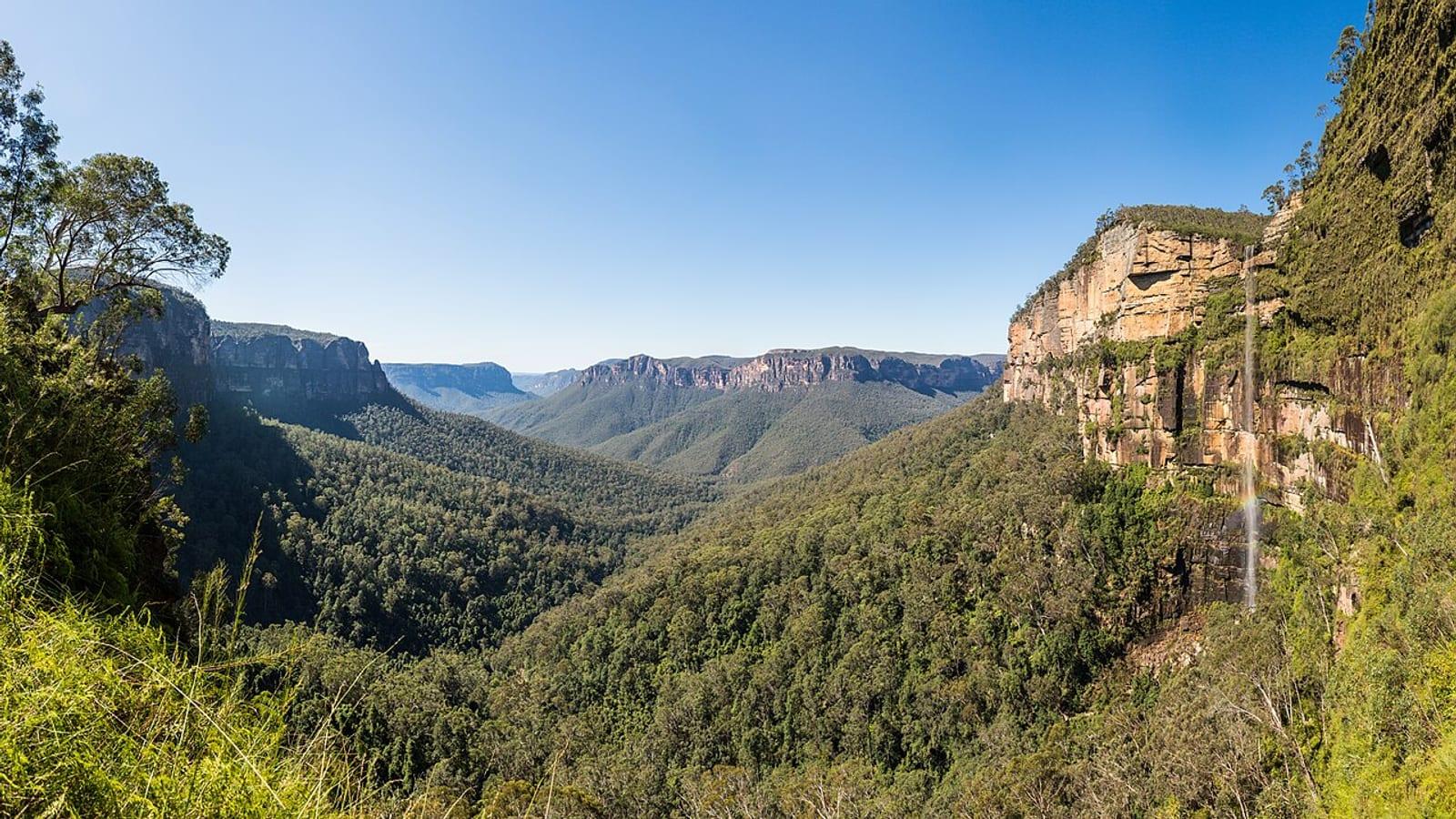
 Grose Valley, NSW, Australia - April 2013.jpg. Photo: Diliff via Wikimedia Commons (CC BY-SA 3.0)
Location and Directions
Address
Wellington Caves, 2733 Caves Road, Wellington, New South Wales 2820.
Directions
From Sydney, take the Great Western Highway (A32) west to Bathurst, then continue on the Mitchell Highway (A32/B55) northwest to Wellington. Total distance from Sydney is approximately 355 km, taking around 4 hours by road. From Dubbo, head south on the Mitchell Highway for approximately 50 km. Wellington township is the main reference point; Wellington Caves is located 8 km south of the town centre on Caves Road.
Parking is available on-site in a sealed car park near the visitor centre. There is no charge for parking. The site has coach and caravan parking. Facilities at the caves include a café, a holiday park with cabin and powered site accommodation, a wildlife and education centre, and picnic grounds.
What Fossils You'll Find
Wellington Caves contains Pleistocene fossil deposits of exceptional richness. The fossil material accumulated over hundreds of thousands of years as animals fell into natural vertical shafts in the limestone and were subsequently flooded by the rising water table, leading to rapid burial and preservation in fine-grained sediment.
 Diprotodon skeleton, from Stromer, E. (1910). Lehrbuch der Paläozoologie. Vol. 2.jpg. Photo: Ernst Stromer via Wikimedia Commons (Public domain)
Diprotodon optatum — the largest marsupial that ever lived, reaching the size of a rhinoceros — is represented by multiple individuals in the Wellington deposits. Skull fragments and limb bones have been recovered from several of the cave chambers.
Thylacoleo carnifex, the marsupial lion, is known from complete skulls recovered at Wellington. Its dentition — reduced incisors and large, blade-like premolars acting as carnassials — identifies it as an apex predator despite its relationship to herbivorous possums and wombats.
Procoptodon goliah, the giant short-faced kangaroo standing up to 2 metres tall, has been identified from limb bones and jaw fragments. Several species of large macropods are present in the assemblage, reflecting the diversity of the Pleistocene grassland and woodland fauna that lived across central New South Wales.
The Phosphate Mine tour passes through workings from 1914 to 1918, when bone-bearing phosphate-rich sediments were mined for agricultural fertiliser. The bones in the matrix are Pleistocene megafauna remains, and during the Phosphate Mine tour you can see fossil bones still visible in the mine walls at close range.
Wellington Caves also sits within Devonian limestone. The limestone itself contains marine fossils from approximately 360 to 415 million years ago, though these are not the primary visitor draw and are difficult to spot without a hand lens and a guide's assistance.
Geologic History
The Ancient Environment
The limestone in which Wellington Caves are developed was deposited during the Devonian Period, approximately 360 to 415 million years ago, in a shallow tropical sea that covered much of central New South Wales. Carbonate sediments — the shells, skeletons, and excretions of marine organisms — accumulated on the seafloor and were compressed over millions of years into the dense limestone now visible in the cave walls. The rock type is Silurian to Devonian reef limestone, and the original marine fauna is preserved as moulds and calcite replacements within the rock matrix.
The Pleistocene fossil deposits are much younger — generally dated to between approximately 40,000 and 500,000 years ago. During this period, central New South Wales supported open woodland and grassland vegetation, and the megafauna that lived in these habitats were diverse and abundant. The vertical shafts and sink holes that characterise the surface above the cave system acted as natural pitfall traps. Animals that fell in — or were washed in during flood events — were preserved in the accumulating sediment inside the caves.
How Wellington Caves Became a Fossil Viewing Site
Cave development at Wellington began when acidic groundwater, charged with carbon dioxide from soil, began dissolving the Devonian limestone along joints and fractures. This process, known as karstification, has been operating for millions of years and has produced the multi-level passage system now explored on guided tours. The fossil deposits were first scientifically documented in 1830 when Thomas Mitchell collected bones from Bone Cave and forwarded them to London. Richard Owen's identification of the material as giant marsupials made Wellington internationally significant overnight. The site has been open to visitors in various forms since the nineteenth century and today is managed by Wellington Caves Reserve, a NSW Government asset. Ongoing research by university and museum teams continues to document new species from the deposits.
Visiting Rules and Regulations
Is Fossil Collecting Allowed?
Fossil collecting is strictly prohibited. Wellington Caves is a protected site under the NSW Heritage Act 1977 and the Commonwealth EPBC Act 1999. All fossil material in the caves is protected for scientific research and public education. Removing any material, including loose rock fragments, is an offence. Visitors may observe fossil material during guided tours and photograph the cave environment.
Recommended Equipment
Enclosed footwear is required for all cave tours — thongs, sandals, and open-toed shoes are not permitted inside the caves. The cave temperature is a constant 17°C year-round, which feels cool in summer and relatively mild in winter. Bring a light jacket. Tours are guided, so no specialist equipment is required. Cameras without flash are generally permitted; confirm with your guide at the start of the tour. The Phosphate Mine tour is the most accessible, being suitable for wheelchairs and prams. Cathedral and Gaden caves involve steps and uneven surfaces and are not wheelchair accessible.
Safety
All tours at Wellington Caves are led by trained guides. Do not enter any cave passage without a guide. The caves contain natural hazards including uneven floors, low ceilings in some sections, and areas of potential flooding during heavy rain. Persons with claustrophobia should discuss their concerns with staff before booking a tour. Threatened bent-wing bats (Miniopterus schreibersii) roost in the cave system — do not disturb bat colonies or attempt to enter restricted bat habitat areas. Tour bookings are recommended to secure a place, particularly during school holidays and long weekends.
Sources
- https://www.wellingtoncaves.com.au/
- https://www.environment.nsw.gov.au/heritageapp/ViewHeritageItemDetails.aspx?ID=2110069
- https://australianmuseum.net.au/learn/australia-over-time/fossil-sites/wellington-caves/
- https://en.wikipedia.org/wiki/Wellington\_Caves
- https://www.nationalgeographic.com/science/article/pleistocene-megafauna-australia
Nearby sites
 Talbragar Fossil Site Jurassic Fish Gulgong Fossil Hunting GuideFish, Plants
 Flat Rocks Inverloch Dinosaur Dig Site Fossil Hunting GuideStrzelecki Group, Polar dinosaurs
 Woolshed Creek Fossil Hunting GuideLocation of Fossil Site, Fossil Collecting
 Lightning Ridge Opalised Dinosaur Fossils Fossil Hunting GuideAustralian Opal Centre, Griman Creek Formation