Find Fossils at Tidmoor Point Fossil Hunting Guide
Tidmoor Point on the Fleet lagoon in Dorset exposes Oxford Clay yielding pyritised ammonites, crustaceans, belemnites, and marine reptile fragments in a sheltered SSSI.
Tidmoor Point is a small promontory on the northern shore of the Fleet lagoon, the sheltered tidal lagoon behind Chesil Beach in Dorset. The site exposes the Oxford Clay Formation in a section of very low cliffs and foreshore, and it is known among specialist collectors for the quality of its preservation. Ammonites here occur as pyrite and limonite casts, the iron-mineral replacements giving them a striking metallic or rusty gold appearance quite different from the chalky or mudstone-moulded specimens found at many other Jurassic Clay sites. Belemnites, crinoids, crabs, lobsters, sharks, marine reptile fragments, and fish also occur in the Oxford Clay at this locality. The Fleet lagoon setting makes Tidmoor Point unusual. The lagoon is managed as a Site of Special Scientific Interest for its ecology, and the foreshore here is quieter and more sheltered than the open Dorset coast. Access requires some care over permissions and local conditions, but for collectors seeking quality pyritised ammonites in a genuinely unusual setting, it is worth the effort. This guide covers how to reach the site, what you are likely to find, the Callovian-Oxfordian geology, and the permissions situation.
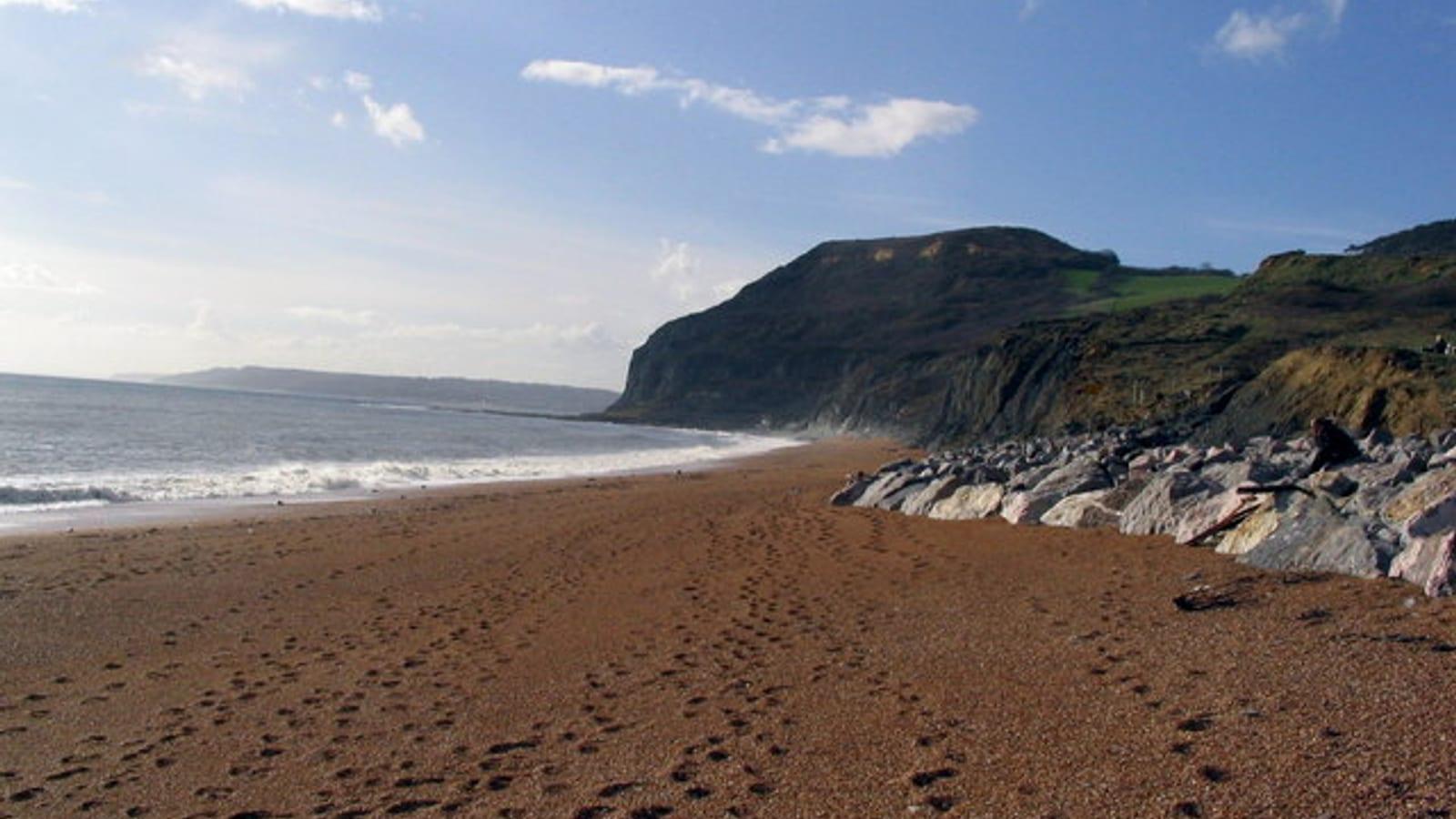
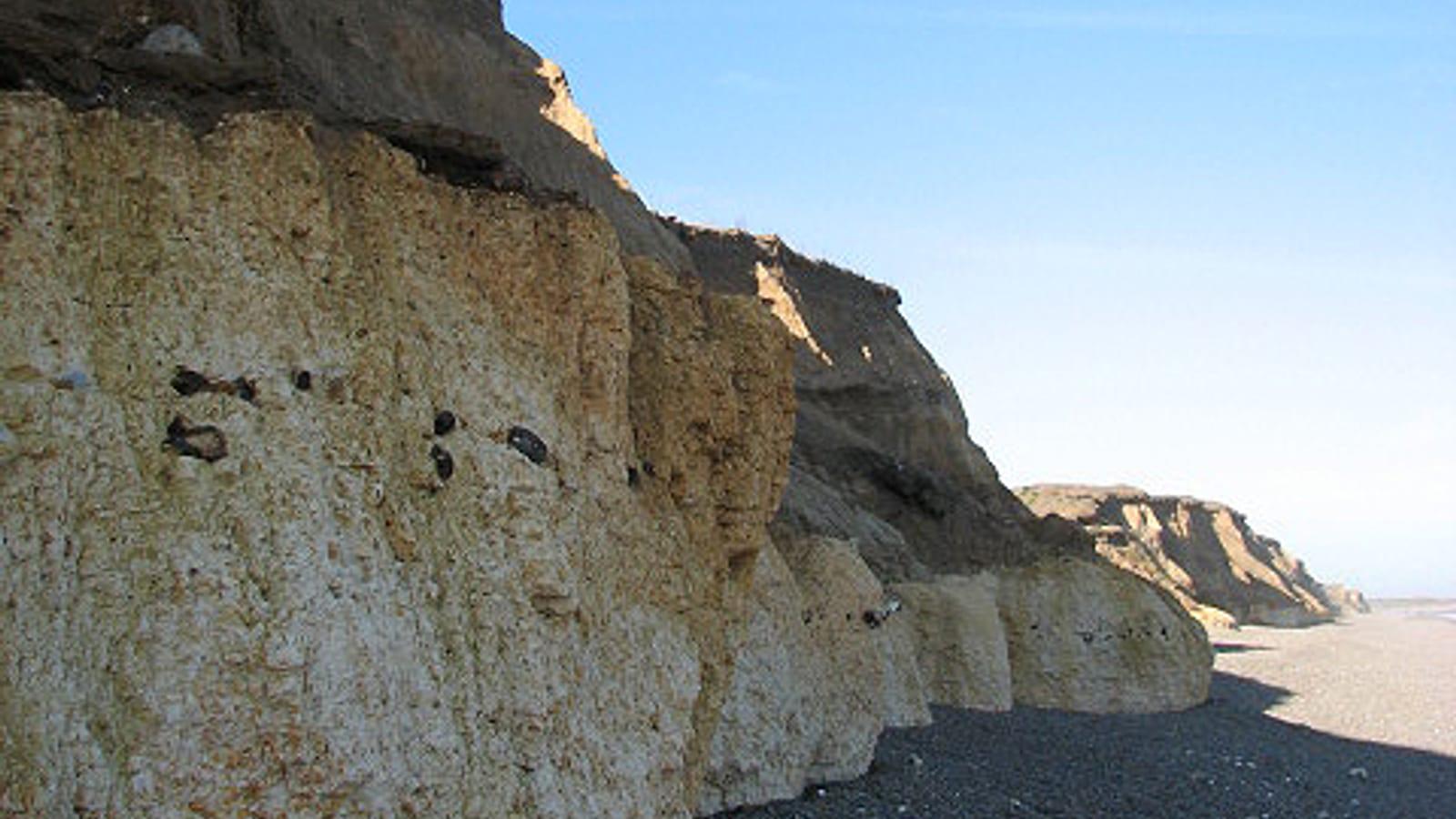
 Chalk cliffs and shingle beach, England. Photo: Wikimedia Commons contributor via Geograph (CC BY-SA 2.0)
Location and Directions
Address
Tidmoor Point, Fleet lagoon, near Langton Herring, Dorset DT3, England. The point sits on the northern shore of the Fleet, approximately 1.5 km south of Langton Herring village and 7 km northwest of Weymouth.
Directions and Parking
From the B3157 coast road between Weymouth and Bridport, turn south toward Langton Herring at the signed turning east of Abbotsbury. Follow the narrow lane into Langton Herring village. The road does not continue directly to the Fleet shore; you must walk south from the village across the fields using the public footpath that leads down to the Fleet bank. The walking distance from the village to Tidmoor Point is approximately 1.5 km on uneven field and grassland paths. Park considerately in Langton Herring village, in the small parking area near the pub or in a suitable roadside spot without blocking farm access. There is no dedicated car park for the Fleet shore at this point. An alternative approach is from Rodden to the west, which also has footpath access to the Fleet bank; check current footpath routes on Ordnance Survey 1:25,000 map OL15 (Purbeck and South Dorset) before visiting. Note that the Fleet lagoon shore at Tidmoor Point is accessed via private farmland traversed by public footpaths. The footpath gives access for walking; formal permission from the landowner is required if you intend to collect. The Fleet is also a wildfowl reserve managed by the Ilchester Estate; check with the estate for access arrangements.
What Fossils You'll Find
Pyritised and limonitised ammonites are the defining fossils of Tidmoor Point. The Oxford Clay here produces small to medium ammonites, typically 2 to 10 cm diameter, where the original shell material has been replaced by iron pyrite (iron sulphide, giving a brassy or silvery metallic appearance) or limonite (iron hydroxide, giving a rusty gold to brown colour). These replacements form because the shell material acted as a nucleus for iron mineral precipitation during early burial diagenesis. The metallic sheen makes even small specimens instantly recognisable. Cardioceratid ammonites are typical of the Oxford Clay, along with Quenstedtoceras and related genera. Belemnites occur throughout the Oxford Clay as calcite guards; at Tidmoor they are sometimes found with the phragmocone (the chambered internal structure) preserved, which is unusual and scientifically interesting. Crinoid columnals and occasional calyx plates occur in the clay, reflecting the presence of crinoids (sea lilies) on the Callovian sea floor. Complete crinoid specimens are extremely rare in the Oxford Clay, but associated plates from disrupted specimens appear in localised horizons. Crustaceans, including crabs and lobsters, are among the more notable finds at Tidmoor. The Oxford Clay is one of the better British formations for Jurassic crustaceans, and the sheltered depositional conditions here favoured their preservation. Claws and carapace fragments are the typical recovery, though occasionally more complete specimens are found. Marine reptile material, including isolated vertebrae and bone fragments from ichthyosaurs and plesiosaurs, has been recorded from the Oxford Clay at various Dorset Fleet locations. These are rare but worth noting when examining clay blocks. Sharks' teeth and fish vertebrae occur loose in the clay, freed by erosion of the cliff base.
Geologic History
The Ancient Environment
The Oxford Clay Formation at Tidmoor Point was deposited during the Callovian and early Oxfordian stages of the Middle to Late Jurassic, approximately 164 to 157 million years ago. The Oxford Clay is one of the most extensively studied British Jurassic formations; it stretches from Dorset in the south to Yorkshire in the north and was quarried extensively in the 20th century as the raw material for brickmaking, with the Peterborough and Bedford exposures being the most famous. The depositional environment was a moderately deep, quiet offshore shelf sea. Fine organic-rich muds accumulated on the sea floor, and the periodic anoxia of bottom waters limited burrowing activity and allowed organic matter to be preserved alongside fossil material. This is why the Oxford Clay yields such well-preserved specimens and why pyrite replacement is so common: the anoxic conditions promoted early diagenetic pyrite formation within the sediment. The sea surface above was well-oxygenated and productive, supporting abundant plankton and a rich food chain of fish, ammonites, belemnites, sharks, and large marine reptiles. At Tidmoor, the Fleet lagoon setting means that the Oxford Clay is exposed in an unusually sheltered tidal environment rather than on an open coast. The low cliffs here are protected from heavy wave action by the Chesil Beach barrier, which means erosion is gentler and the cliff section is more stable than exposed coastal sites. Tidal fluctuation in the Fleet, though small compared to the open coast, is sufficient to expose and re-cover the clay foreshore with each cycle.
How Tidmoor Point Became a Fossil Collecting Site
The Oxford Clay at Tidmoor is exposed because the Fleet lagoon shoreline has eroded into the hillside sufficiently to cut into the Jurassic sequence beneath the superficial Quaternary deposits. The very low cliff that results, no more than a metre or two in most places, is kept fresh by the tidal action of the Fleet and occasional storm events. Unlike the open Dorset coast, where wave energy is high and cliff erosion can be dramatic, the lagoon setting means that Tidmoor erodes slowly and steadily, maintaining a persistent but modest exposure.
Collecting Rules and Regulations
Is Fossil Collecting Allowed?
Tidmoor Point sits within the Fleet and Chesil Beach SSSI, which is one of the most ecologically sensitive protected areas in Dorset. The SSSI is designated primarily for its ecological interest, including internationally important waterfowl populations and the unique lagoon ecosystem. The Oxford Clay geological exposures are also of scientific interest. Under SSSI rules, any activity that damages or disturbs the special interest of the site requires consent from Natural England. Collecting loose, surface-detached material with hand tools from the foreshore is the accepted minimum-impact approach, but you should contact Natural England's Dorset office to confirm what is currently permitted at this specific location before visiting with intent to collect. The Fleet is managed by the Ilchester Estate, and their permission may also be required for access to the shore beyond the public footpath. This is a site where advance preparation of permissions is more important than at a straightforward public beach.
Recommended Tools
Because this is a sensitive ecological site, keep your toolkit minimal: a geological hammer, one small chisel, and a hand lens are appropriate. Do not bring heavy equipment. Pyritised specimens from the Oxford Clay can be unstable; the iron sulphide in pyrite oxidises when exposed to air and moisture, causing the specimen to crack and crumble over time. Treat any pyritised ammonite with Paraloid B-72 consolidant as soon as possible after collection and store in a dry, stable environment to prevent pyrite decay.
Safety
The Fleet lagoon shore at Tidmoor is relatively sheltered and the terrain is low-lying and easy. The main practical hazards are the tidal mudflats on either side of the hard foreshore, which can be slippery and locally deep. Do not step onto the mud beyond the firm shore edge. Wellies or waterproof walking boots are appropriate footwear. Check Fleet tidal conditions before visiting: the lagoon fills and empties slowly but consistently with the tide, and the foreshore exposure window is limited. The walk from Langton Herring crosses agricultural land; close all gates and be aware of livestock.
Sources
- https://www.discoveringfossils.co.uk/tidmoor-point-dorset/
- https://ukfossils.co.uk/tidmoor-point/
- https://earthwise.bgs.ac.uk/index.php/Oxford\_Clay\_Formation
- https://en.wikipedia.org/wiki/Oxford\_Clay
- https://en.wikipedia.org/wiki/The\_Fleet,\_Dorset
- https://jurassiccoast.org/visit/fossil-collecting/