Charmouth Beach Fossil Hunting Guide
Image: Lewis Clarke via Wikimedia Commons
Charmouth Beach yields Jurassic ammonites, belemnites, fish, and marine reptile remains from eroding Blue Lias and Charmouth Mudstone cliffs on the Dorset Jurassic Coast.
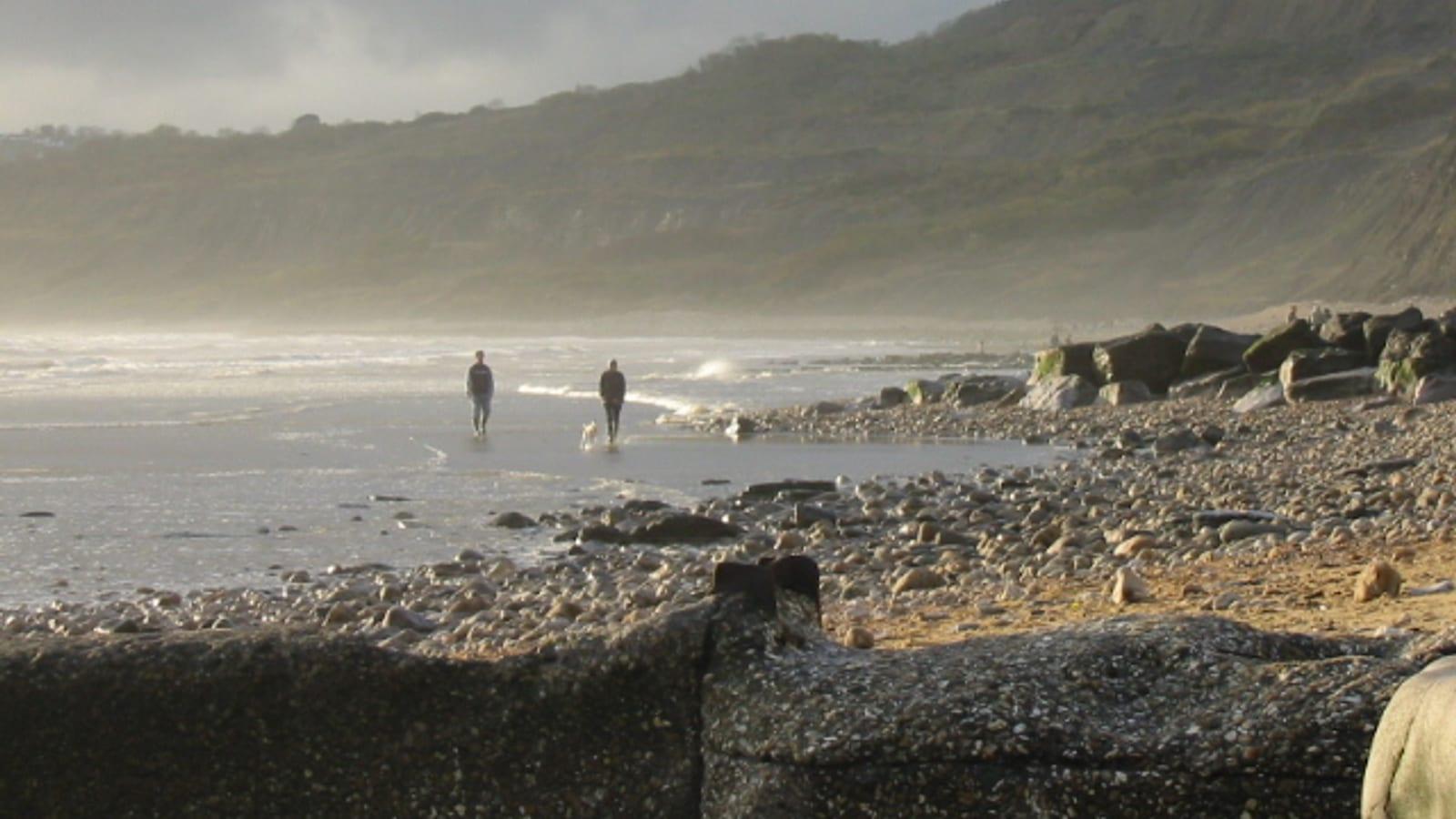
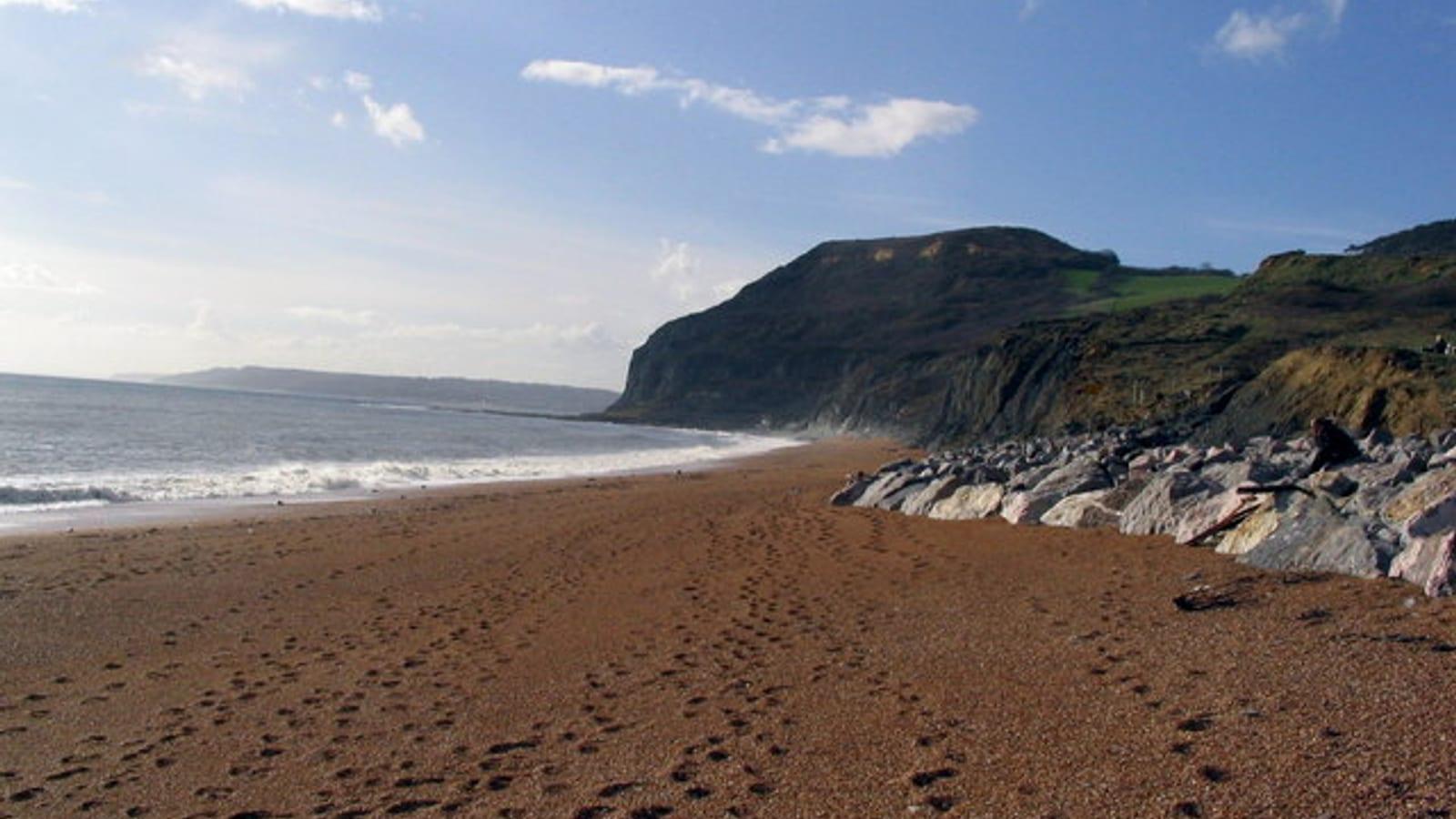
Charmouth Beach in Dorset is one of the most consistently productive fossil collecting sites in Britain and the most accessible entry point to the Early Jurassic of the Jurassic Coast. The beach runs east from the mouth of the River Char towards Black Ven, one of the largest coastal landslides in Europe, where continuous cliff erosion deposits fresh ammonites, belemnites, fish, and occasional marine reptile remains onto the foreshore throughout the year. The cliffs expose the Blue Lias Formation at the base and the Charmouth Mudstone Formation above it, both deposited in a warm subtropical sea approximately 200 to 190 million years ago during the earliest Jurassic. This guide covers the beach collecting area specifically: how to reach it, what the tidal foreshore yields, and how to work the site safely and within the rules.
Charmouth is distinguished from adjacent Lyme Regis by its dedicated beach infrastructure for fossil hunters. The Charmouth Heritage Coast Centre provides free expert identification, guided fossil walks, and practical advice. For anyone new to fossil hunting on the Jurassic Coast, Charmouth is the best place to start.
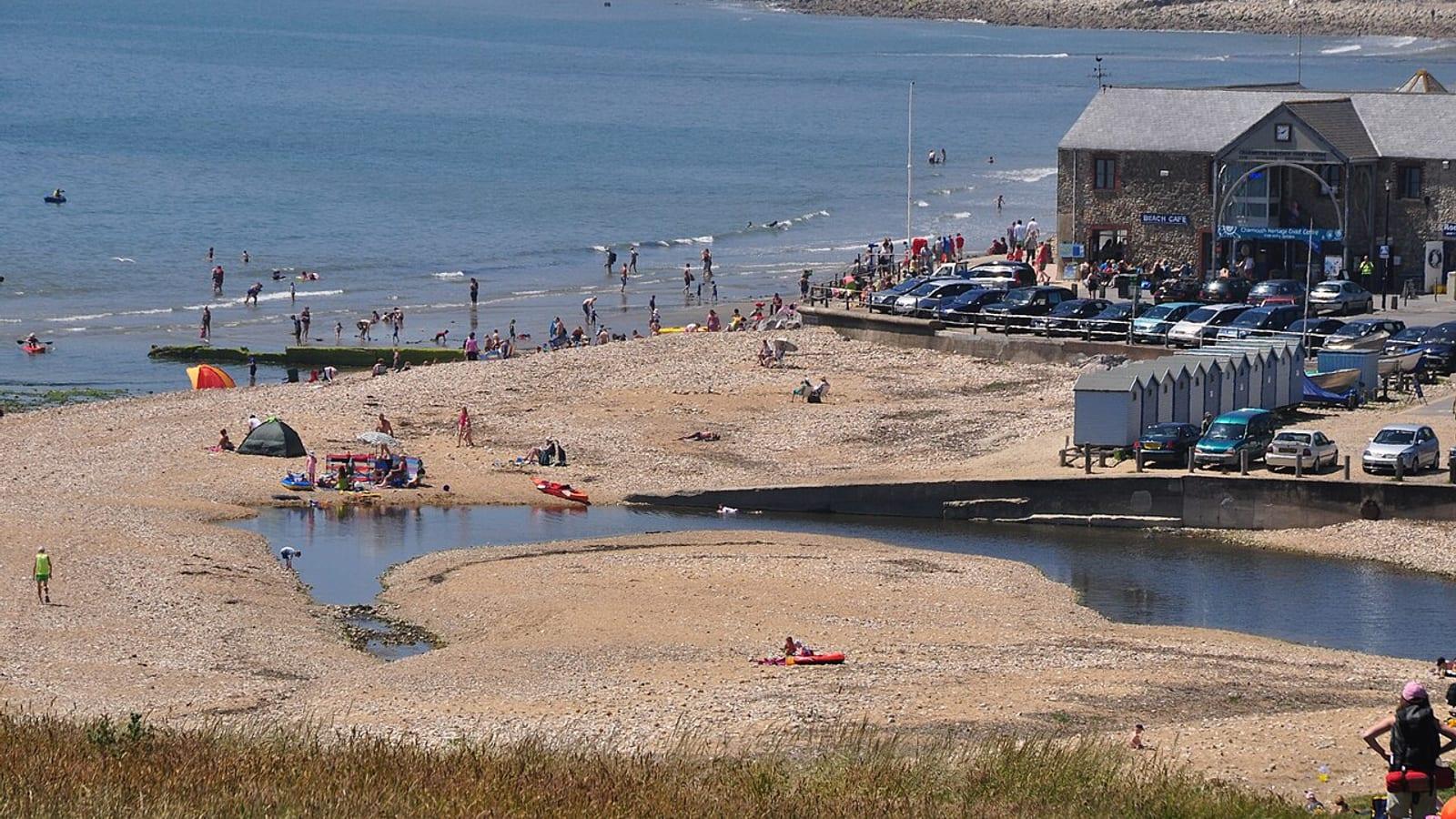
 West Dorset , Charmouth Beach - geograph.org.uk - 3555340.jpg. Photo: Lewis Clarke via Wikimedia Commons (CC BY-SA 2.0)
Location and Directions
Address
Charmouth Beach, Lower Sea Lane, Charmouth, Bridport, Dorset DT6 6LL, England. GPS: 50.733°N, 2.891°W.
Directions and Parking
Charmouth is on the A35 between Lyme Regis and Bridport. Turn south off the A35 into the village and follow Lower Sea Lane all the way to the beach. The main car park, Charmouth Foreshore Car Park, is at the end of Lower Sea Lane adjacent to the beach and Heritage Coast Centre. It operates as pay and display: £7 per day or £1.50 per hour between 9am and 9pm, with cash and card accepted. The JustPark app also works here. The car park has 50 standard spaces plus 25 overflow spaces, 2 motorcycle bays, and 2 disabled bays. Vehicles over 4.8 metres in length are not permitted; coaches should use the dedicated coach park 500 metres back on Lower Sea Lane. Overnight parking is not allowed. Two additional private car parks (Beach Car Park and Field Car Park) offer approximately £6 per day during peak season and are a short walk from the beach.
From the car park, the beach is directly in front of you. Walk east along the foreshore, past the river mouth (cross via the footbridge or wade at low tide) to reach the most productive section below Black Ven. The stretch between the river mouth and the Black Ven cliffs is where the great majority of foreshore collecting occurs. Walk east at low tide: the productive area extends for several hundred metres and the amount of material visible on the foreshore increases after storms and following cliff falls.
Public toilets are available at the car park. The Heritage Coast Centre is open year-round and has a café. The village has fossil shops, a pub, and a small supermarket. Charmouth is about 1.5 miles from Lyme Regis along the coastal path.
What Fossils You'll Find
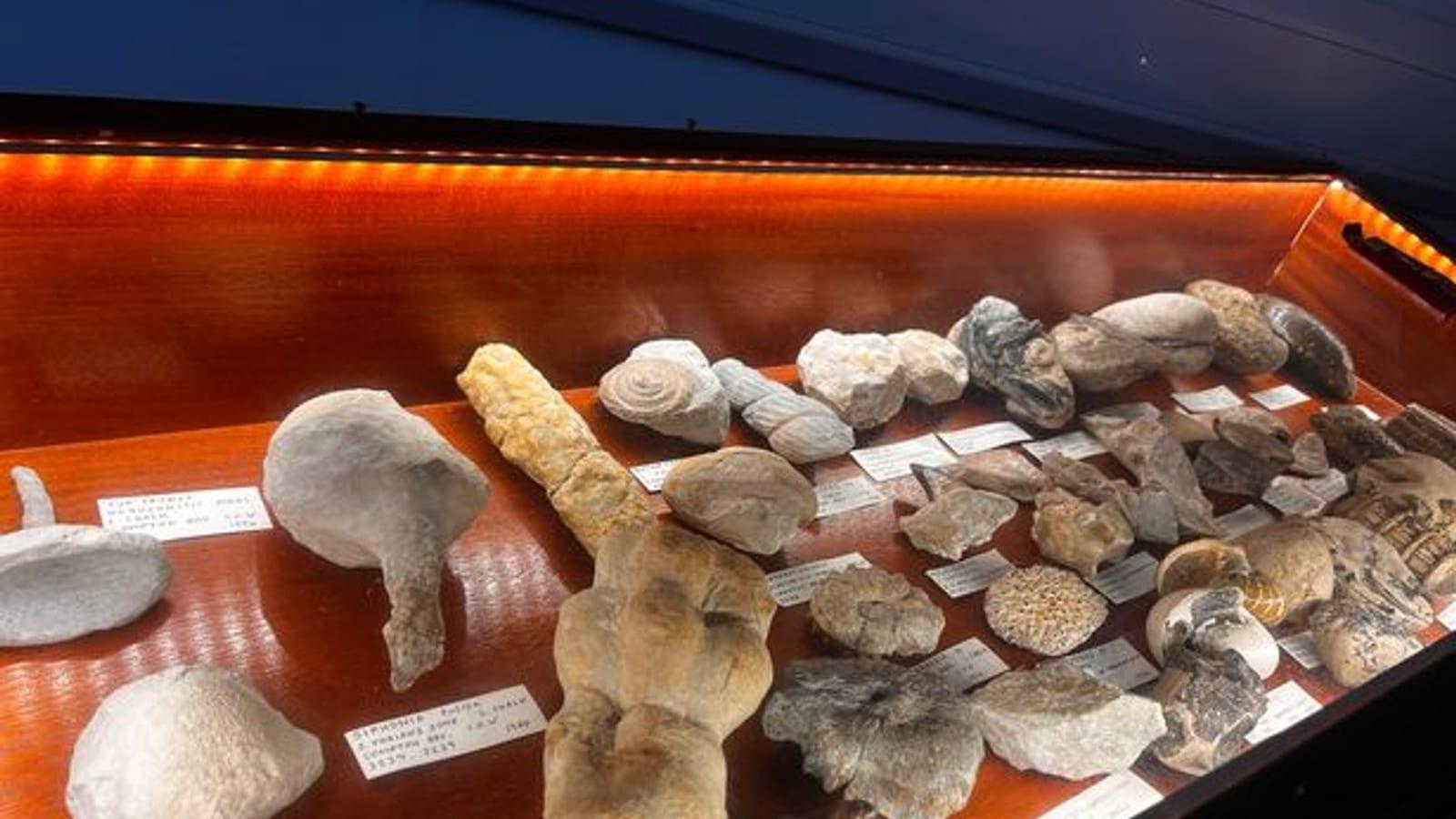
Ammonites are the most sought-after and most commonly found fossil at Charmouth. Multiple species occur across the Blue Lias and Charmouth Mudstone sequence: Arnioceras semicostatum, Asteroceras stellare, Echioceras, Promicroceras, Microderoceras birchi, Xipheroceras, Eteoderoceras, Androgynoceras, and Platypleuroceras brevispina are all recorded. Pyritised ammonites are particularly common and attractive, their surface preserved in golden iron pyrite. These tend to occur in the Grey Shale Member and in nodules weathering from the shale. Three-dimensional limestone-filled specimens come from the harder limestone beds of the Blue Lias. Look for rounded nodules on the foreshore surface: breaking these open is not permitted under SSSI rules, but those already cracked or split by wave action sometimes reveal ammonites inside.
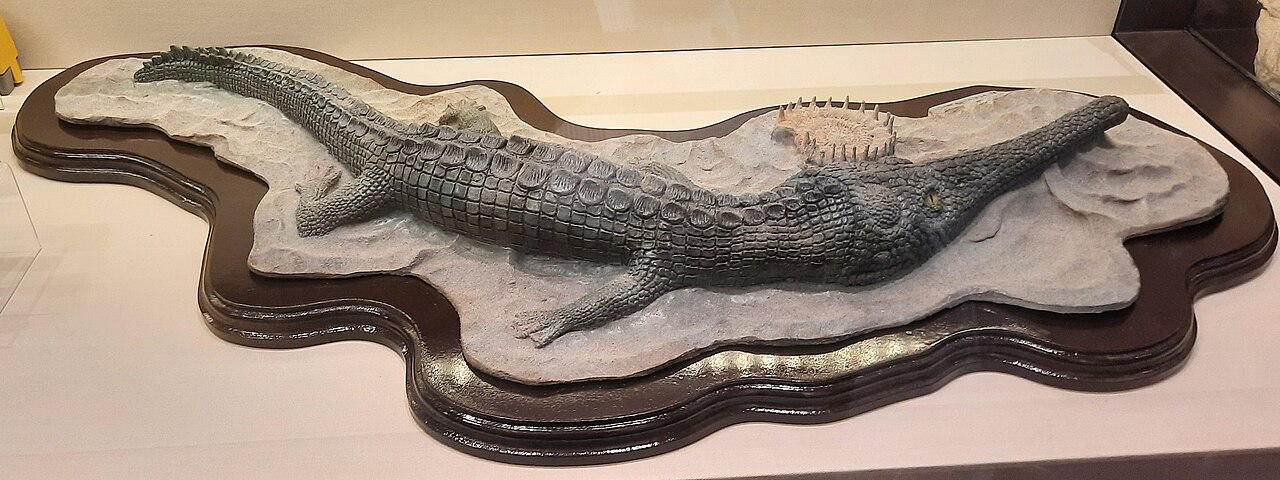 Turnersuchus model.jpg. Photo: Harold9595959 via Wikimedia Commons (CC BY-SA 4.0)
Belemnites are extremely common and found in large numbers across the foreshore. The bullet-shaped guards are robust and survive wave action well. They accumulate in tidal pools and in shingle pockets between limestone ledges. Finding belemnites confirms you are working a productive area.
Bivalves including Gryphaea (the Devil's Toenail) are abundant in the limestone beds of the Blue Lias. Their curved, heavily ribbed shells are robust and recognisable. Crinoid ossicles occur in the limestone bands. Brachiopods and gastropods are present but less common than the cephalopods and bivalves.
Fish remains, including complete skeletons preserved in flatstone nodules with scales intact, occur in the mudstone sequence. Complete fish are rare but found regularly enough by experienced collectors. Look for oval nodules with a slightly different texture than the surrounding shale. Coprolites (fossilised faeces), first correctly identified by Mary Anning and William Buckland from this area, are also present in the shale.
Marine reptile remains are the most exciting finds and include ichthyosaur vertebrae, ribs, and occasional skull elements. Plesiosaur bones have also been found here. These are uncommon and significant; Mary Anning's 1811 to 1812 ichthyosaur excavation near Charmouth established this as a world-class marine reptile site. In 2020, 11-year-old Ruby Reynolds found ichthyosaur fragments on the beach near Mary Anning's original collecting area. If you find what appears to be a large vertebra, paddle element, or skull bone, do not attempt to extract it; photograph it and contact the Charmouth Heritage Coast Centre or the Lyme Regis Museum.
Geologic History
The Ancient Environment
The cliffs at Charmouth expose two Early Jurassic formations. The lower unit is the Blue Lias Formation (Hettangian to early Sinemurian, approximately 201 to 196 million years ago), a sequence of interbedded limestone and dark shale deposited in a shallow, warm, subtropical to warm-temperate sea. Above it lies the Charmouth Mudstone Formation, including the Black Ven Marl Member and the Shales-with-Beef Member, extending through the Sinemurian stage to approximately 190 million years ago. The Shales-with-Beef are named for the fibrous calcite veins that run through them, resembling the grain of raw meat in outcrop.
Britain during the Hettangian and Sinemurian lay at approximately 20 to 30 degrees north paleolatitude in a warm greenhouse world. No polar ice existed, and global sea levels were relatively high. The sea covering southern Britain was warm, clear in its upper layers, and rich in marine life including the great ichthyosaurs and plesiosaurs, shoals of fish, ammonites in enormous variety, belemnites, crinoids, and a diverse benthic community of bivalves, gastropods, and brachiopods. The seafloor in the Charmouth area was frequently oxygen-poor, which is why marine reptile skeletons are preserved here rather than scattered by scavengers: a dead ichthyosaur sinking to the anoxic seabed was preserved in the dark organic-rich mud that has since become the black shales visible in the cliff face.
The cyclic alternation of limestone and mudstone in the Blue Lias, visible as light and dark bands in the cliff from a distance, reflects Milankovitch orbital cycles: variations in Earth's orbit and axial tilt that drove periodic changes in sea level, temperature, and seafloor oxygenation. Each limestone-mudstone couplet represents thousands of years of deposition. The Shales-with-Beef above record a period of organic-rich, low-oxygen seafloor conditions with periodic carbonate saturation events that formed the distinctive calcite veins.
How Charmouth Beach Became a Fossil Collecting Site
Charmouth Beach owes its productivity to one of Europe's largest active coastal landslide systems. Black Ven, the massive dark cliff east of the river mouth, is composed of the soft Charmouth Mudstone Formation and is subject to continuous erosion by wave action at its base, rainfall infiltration from above, and periodic large-scale landslides. Winter storms are particularly effective: they undercut the cliff base, destabilise large sections above, and deliver masses of fossil-bearing mudstone to the foreshore. The local saying that 'worse the weather, better the fossil hunting' is literally true: a severe winter storm followed by a spring low tide can expose more fresh material in a single tide than a calm summer week. The same unstable geology that makes Black Ven dangerous for close approach also ensures a constant supply of new fossils to the foreshore below.
Collecting Rules and Regulations
Is Fossil Collecting Allowed?
Collecting loose fossils from the beach and foreshore at Charmouth is permitted and encouraged as an activity. The foreshore is free to access; no permit or fee is needed to pick up loose material from the beach for personal, non-commercial use. Charmouth is part of the UNESCO Jurassic Coast World Heritage Site and carries SSSI designation. These designations mean that hammering cliff faces, breaking in-situ rock, and bulk or commercial collection are all prohibited. The collecting that is permitted and widely practised here is surface picking of loose material already on the foreshore. If you find significant vertebrate material, particularly marine reptile bones, report it to the Charmouth Heritage Coast Centre rather than attempting extraction; significant finds may require professional excavation to recover properly and safely.
Recommended Tools
A small trowel or wooden spatula to shift loose shingle is useful. A hand lens at 10x magnification helps identify smaller specimens and examine ammonite ornamentation. Bring sealable bags and small foam-padded boxes for fragile specimens. Pyritised ammonites can be brittle; wrap them carefully. Waterproof boots with ankle support are recommended; the foreshore is uneven, wet, and slippery on clay and wet limestone. Bring water and weather-appropriate clothing; the beach is exposed and conditions can change quickly.
Safety
Black Ven cliff is actively eroding and dangerous. Do not approach the cliff base; rockfalls and landslides can happen without warning at any time. The productive collecting area is the open foreshore, not the cliff base, and excellent specimens are found well away from the cliffs. Check tide times before visiting: the foreshore narrows significantly on the incoming tide, and some sections east of the river can be cut off. Cross the River Char via the footbridge (not always in place in winter after flood damage) or wade at low tide; the river is shallow but can run fast after rain. The Heritage Coast Centre has current local information on tide times, recent cliff activity, and site conditions. In summer, the beach and car park are extremely busy from mid-morning; arrive early to park and to find undisturbed foreshore.