Druidston Haven Pembrokeshire Fossil Hunting Guide
Image: Dave Kelly via Wikimedia Commons
Druidston Haven in Pembrokeshire exposes Ordovician graptolite shales and Carboniferous plant sandstone on the same foreshore. SSSI; loose material may be collected.
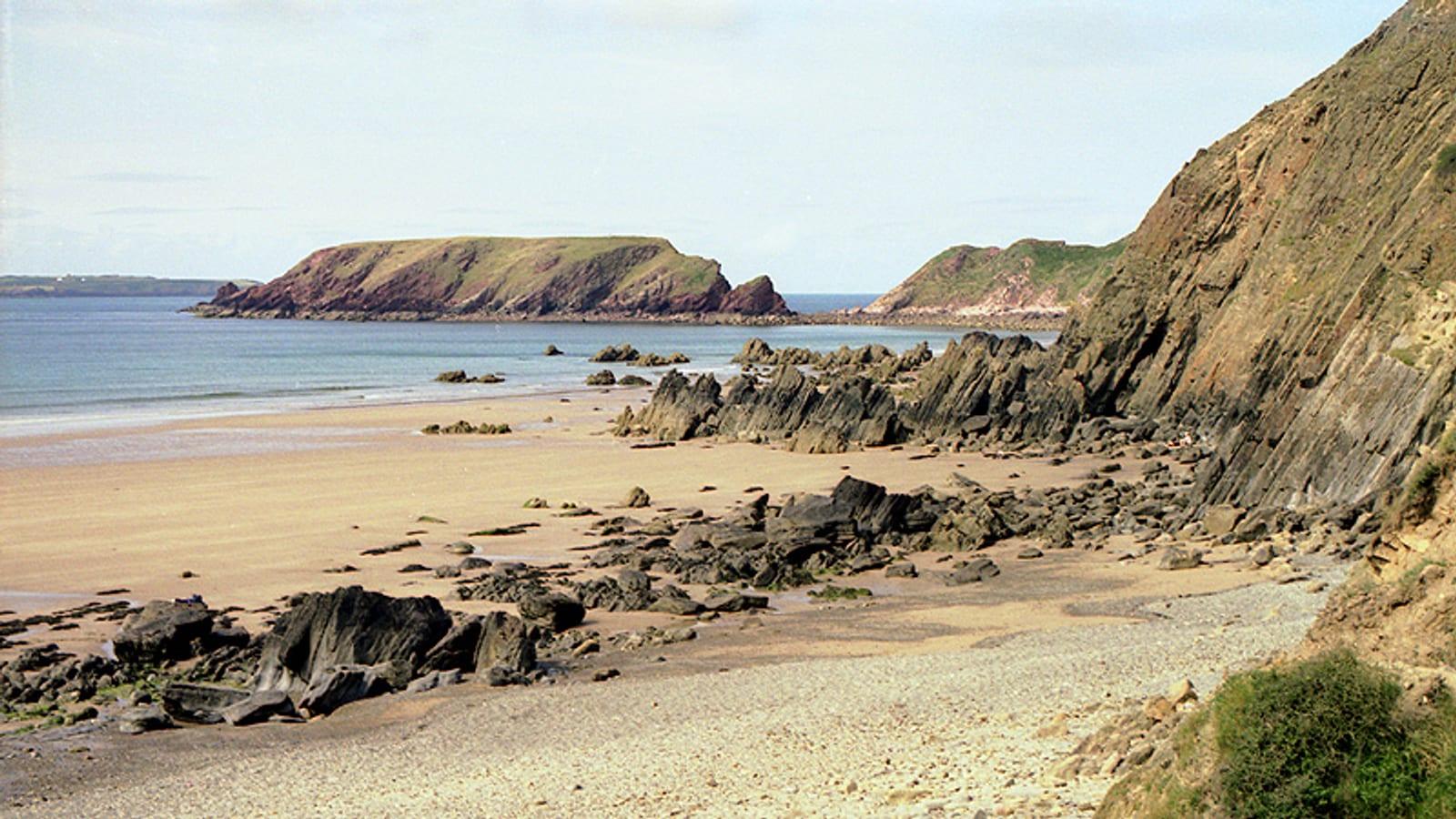
Druidston Haven in Pembrokeshire is one of Wales's most geologically layered fossil sites. The foreshore and loose beach blocks expose two entirely separate fossil-bearing sequences from very different geological periods: Ordovician graptolite-bearing shales approximately 461 to 451 million years old, and Carboniferous plant-bearing sandstone approximately 310 to 307 million years old. The fact that these two sequences occur side by side, separated by nearly 150 million years of geological time, reflects significant tectonic disruption: the older Ordovician shales have been faulted and folded above the younger Carboniferous rocks, inverting the normal stratigraphic order.
Druidston Haven is part of the Pembrokeshire Coast SSSI. Loose pebbles and smaller rocks on the foreshore may be examined and collected; the cliffs and large boulders must not be damaged. Graptolites are abundant once you locate the correct loose cobbles of dark mudstone shale. This guide covers how to reach the beach, where to find the productive blocks, and how to collect responsibly.
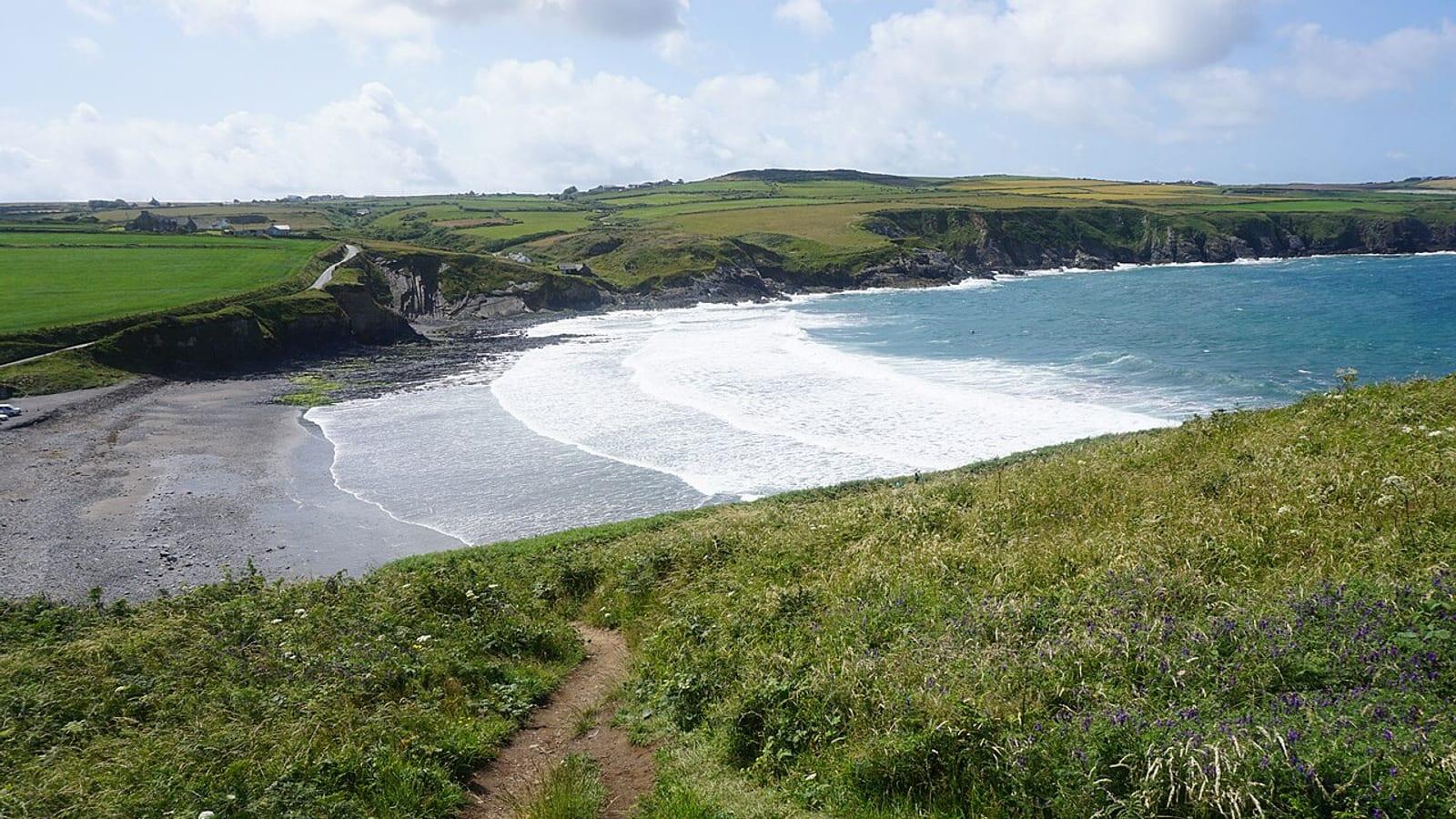
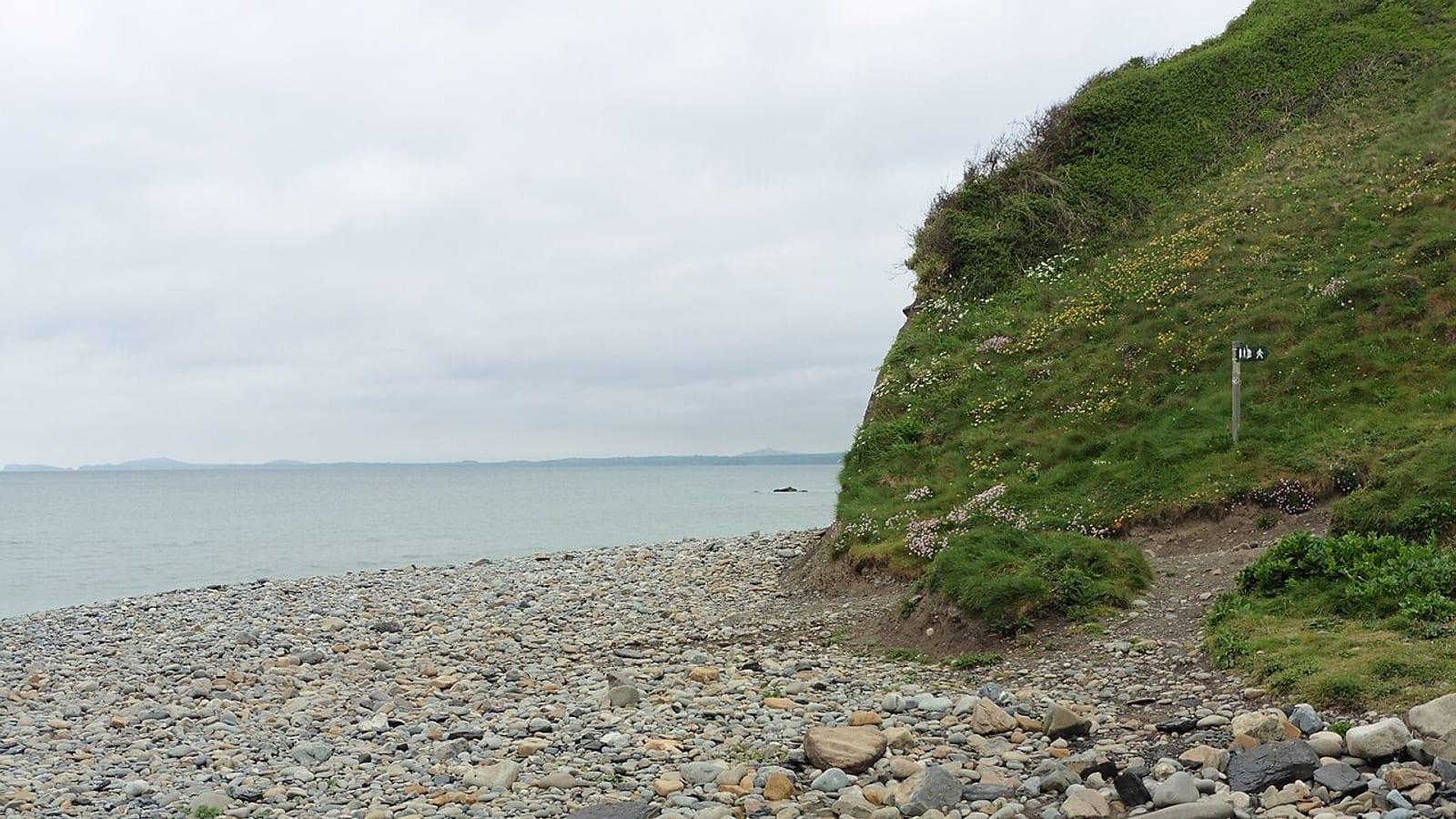
 The Pembrokeshire Coast Path at Druidston Haven - geograph.org.uk - 5433360.jpg. Photo: Dave Kelly via Wikimedia Commons (CC BY-SA 2.0)
Location and Directions
Address
Druidston Haven, near Broad Haven, Pembrokeshire, Wales, SA62 3NE.
Directions and Parking
From Haverfordwest, take the B4341 west towards Broad Haven. Before reaching Broad Haven, follow minor road signs north towards Druidston. The narrow road passes the clifftop Druidstone Hotel, which is visible on the right as a prominent building above the bay. Lay-by parking is available alongside the road near the beach access path. The path descends approximately 100 metres to the sandy beach. At the beach, the productive Ordovician mudstone shales occur as loose foreshore blocks, particularly in the sheltered areas of the bay. Carboniferous Pennant Sandstone blocks are also present on the foreshore. The approach roads are narrow and not suitable for coaches. The site is part of Pembrokeshire Coast National Park.
What Fossils You'll Find
Graptolites are the primary fossil at Druidston Haven, and they are abundant in the Ordovician shale blocks once you find the right material. The productive blocks are dark, almost black mudstone with a fissile, splitting character. Graptolites appear as silvery or white saw-tooth impressions on the bedding plane surfaces. The dominant group here is the diplograptids, which have two rows of thecae (the cups that housed individual graptolite zooids) arranged back to back along the stipe. They appear as fine herringbone or ladder-like impressions and are found both on bedding plane surfaces and dissecting obliquely through the rock.
 Estonian Museum of Natural History Specimen No 171448 photo (g1 g1-295 1 jpg).jpg. Photo: Mai Seppel via Wikimedia Commons (CC BY-SA 4.0)
The technique is to collect a loose shale cobble and split it carefully along the natural bedding planes using a geological hammer and thin chisel. The fossils lie flat on these surfaces. A single cobble can yield dozens of well-preserved graptolite impressions. The Ordovician Mydrim Shales here belong to the Caradoc-Ashgill stages and contain a graptolite fauna broadly comparable to that of Dobs Linn in the Borders, though the specific assemblage differs.
In the Carboniferous Pennant Sandstone blocks, plant fossil impressions are the main find. These include frond impressions and stem casts from the tropical swamp forests that covered South Wales during the Westphalian stage. The contrast between the deep-water marine environment of the Ordovician shales and the terrestrial swamp environment of the Carboniferous sandstone, visible within a few metres of each other on the same beach, is what makes Druidston Haven particularly instructive as a geological locality.
Geologic History
The Ancient Environment
The Ordovician Mydrim Shales at Druidston Haven were deposited in deep marine conditions during the Caradoc and Ashgill stages, approximately 461 to 451 million years ago. The Iapetus Ocean covered this region of Wales during the Ordovician, and the black shales accumulated in deep, poorly oxygenated bottom waters where graptolite colonies that had drifted in the surface waters above were preserved after death and sinking. The folds, faults, and contortions visible in the Ordovician shales at Druidston reflect the Caledonian and later Variscan mountain-building events that deformed these rocks after deposition.
The Carboniferous Pennant Sandstone belongs to the Westphalian stage, approximately 310 to 307 million years ago, and represents coastal swamp and floodplain deposits at the western edge of the South Wales Coalfield. This is the only exposure of Upper Westphalian strata in the western South Wales Coalfield. The tropical forests of the Carboniferous coalfield, dominated by giant lycopsid trees and tree ferns, produced the coal seams and plant-bearing sandstones that characterise the Westphalian across South Wales. Wales lay near the equator at this time, in a hot, humid climate that sustained lush vegetation.
The structural relationship between the two rock units, with older Ordovician rocks sitting above younger Carboniferous ones, results from thrust faulting during the Variscan orogeny, which folded and faulted the South Wales sequences during the Late Carboniferous and Permian. Druidston Haven is consequently an important locality for demonstrating structural geology and the concept of tectonic inversion to students of geology.
How Druidston Haven Became a Fossil Collecting Site
The beach at Druidston Haven is maintained as a fossil collecting site by the ongoing erosion of the Pembrokeshire cliffs by the sea. Storm waves regularly dislodge blocks of both the Ordovician shale and the Carboniferous sandstone from the cliff face, delivering fresh material to the foreshore. The loose cobble and boulder population on the beach is constantly being turned over and refreshed by successive storms. The site's SSSI designation protects the in-situ cliff exposures from collection or damage while allowing the examination and collection of detached loose material on the foreshore.
Collecting Rules and Regulations
Is Fossil Collecting Allowed?
Druidston Haven is part of the Pembrokeshire Coast SSSI and Pembrokeshire Coast National Park. Loose pebbles and smaller rocks on the foreshore may be examined and collected responsibly. Large boulders and the cliff faces must not be damaged or hammered. You should collect only material that is already detached from the cliff. The National Park and Natural Resources Wales ask that collecting be for personal interest and not commercial gain. The site's dual geological significance means that it attracts geological field parties, and visitors should be considerate of the ongoing scientific value of the exposure.
Recommended Tools
A geological hammer and thin cold chisels for splitting shale blocks along bedding planes are all that is needed to find graptolites here. Newspaper or tissue paper for wrapping specimens is advisable. The Carboniferous sandstone is harder to split but plant impressions can be found on exposed block surfaces without splitting. A hand lens is useful for examining fine graptolite detail.
Safety
The cliff at Druidston Haven is composed of both rock and unconsolidated material and can shed debris. Do not approach the cliff base. The foreshore is accessible at most states of the tide, but the lower beach is best at low water. The access path from the road is steep and can be muddy. The bay faces southwest and can experience strong swell even in settled weather; do not venture onto the lower rock platforms in rough seas.